
- Home
- Locations
- Turf Installation
- Services
- About
- Recent Projects
- Blog
- Contact
Choosing between artificial turf and natural grass is not always a simple “which one is better?” decision. For HOA boards, sports families, coaches, schools, athletic directors, and community planners, the better question is: which surface fits the way the field or putting green will actually be used?
A backyard practice space, a school athletic field, a football training area, an HOA recreation zone, and an outdoor putting green all have different needs. Some spaces need to handle heavy foot traffic. Others need consistent ball roll. Some need to stay visually clean for residents. Others need to support organized practices, athletic drills, or golf training. The best surface depends on how often the area will be used, who will use it, how much maintenance is realistic, and what local climate conditions the surface has to handle.
In Arizona, that decision comes with added local considerations. Sports fields and putting greens are exposed to intense sunlight, high UV levels, dust, dry soil, compacted ground, monsoon runoff, limited shade, and water-use concerns. A surface that performs well in a mild or rainy climate may not behave the same way in Phoenix, Mesa, Chandler, Gilbert, Scottsdale, Surprise, Goodyear, Queen Creek, Buckeye, or other surrounding communities.
This guide compares artificial turf and natural grass for sports fields, football areas, and putting greens so HOA communities, schools, teams, and families can make a more informed decision. The goal is not to claim that one option is always better. The goal is to compare playability, maintenance, heat, drainage, water use, durability, cost factors, and long-term usability in a practical Arizona context.
Natural grass has a traditional look and feel. It is familiar to athletes, coaches, golfers, parents, and community members. When natural grass is healthy, level, properly irrigated, and well maintained, it can provide a comfortable playing surface with good traction and a softer, living feel underfoot. Many players prefer the natural response of real grass, especially when surface conditions are properly managed.
Artificial turf is designed for consistency. It does not need mowing, overseeding, fertilizing, or the same irrigation schedule as natural grass. It is not dependent on active root growth, seasonal recovery, or daily growing conditions. For fields that see frequent use, artificial turf can be appealing because it provides a more predictable surface across the area, even in high-traffic zones.
A natural grass field can look great when it has enough water, maintenance, sunlight, and recovery time. But when usage is heavy, natural grass can develop bare patches, muddy spots, compacted areas, uneven growth, and worn-out traffic lanes. This is especially common around goal mouths, sidelines, practice zones, tee areas, and repeated footwork areas.
Artificial grass for sports fields is often considered when a property needs a surface that can handle repeated use without relying on grass regrowth. An artificial grass surface used for sports fields can help reduce the visual and functional issues caused by mud, dead spots, and uneven grass wear. However, artificial turf also has its own planning needs, including heat management, infill selection, drainage, cleaning, and periodic maintenance.
The University of Illinois Extension explains that synthetic and natural athletic turf both come with advantages and tradeoffs, including differences in maintenance, temperature, use expectations, and field management. That balanced comparison is important because the right answer depends on the site, the sport, and the maintenance plan.
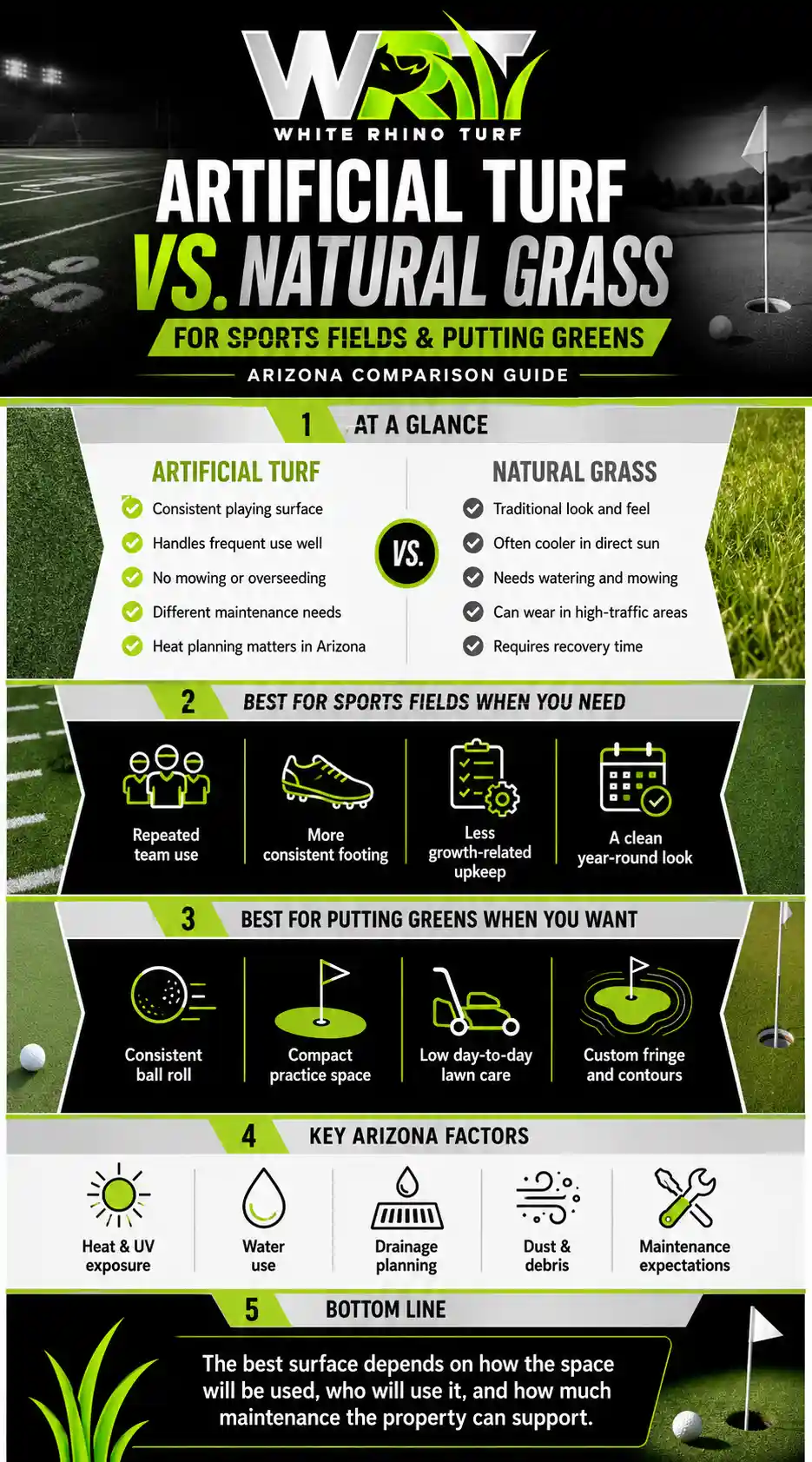
Sports fields are different from regular lawns. A residential lawn may only need to look clean, feel comfortable, and handle occasional use. A sports surface must support movement, traction, ball response, repeated foot traffic, and predictable play. The more organized the activity becomes, the more important surface performance becomes.
A school athletic field may need to support physical education classes, after-school practices, weekend events, and community use. An HOA recreation field may be used by children, families, pets, residents, and informal sports groups. A football training area may need to handle cleats, sprinting, cutting, blocking drills, and repeated impact. A putting green needs a smooth surface that supports predictable ball roll and controlled practice.
Because of these differences, artificial grass for sports fields should not be selected the same way as standard landscape turf. Sports turf needs to be evaluated around use level, sport type, surface expectations, base preparation, infill, pile height, drainage, cleaning requirements, and long-term maintenance.
A multi-use play field does not need the same turf system as a putting green. A football area does not need the same surface as a pet-friendly backyard. A school practice field may need a different design than an HOA amenity space. Matching the turf system to the actual use case is one of the most important steps in creating a surface that performs well over time.
Playability is one of the biggest differences between artificial turf and natural grass. Natural grass changes with weather, watering, mowing, foot traffic, soil conditions, and seasonal stress. When it is properly maintained, many athletes appreciate its feel, traction, and comfort. When it is stressed or uneven, it can create inconsistent footing and unpredictable play.
Natural grass can become slippery when wet, dusty when dry, thin when overused, and uneven when soil compaction develops. In Arizona, natural grass can also struggle with heat stress, irrigation coverage issues, shade patterns, and heavy use during dry conditions. The result may be a field that performs well in some areas but poorly in others.
Artificial turf is designed to create a more uniform surface. The goal is to reduce variation from one area of the field to another. For sports families, HOA communities, schools, and teams, that consistency can be useful because the surface is less dependent on whether grass is actively growing or recovering.
For football, soccer-style drills, agility work, and general athletic training, consistent footing can be a major planning factor. For putting greens, consistency is even more important because small changes in surface smoothness can affect ball roll. Outdoor putting green turf is selected specifically to create a more controlled practice surface than a standard lawn.
That said, consistency does not mean artificial turf is maintenance-free or identical to natural grass. Turf fibers, infill, base preparation, and grooming practices all affect how the surface feels. The best results come from choosing a turf system that is appropriate for the activity rather than choosing turf based only on appearance.
Football areas place heavy demands on a surface. Cleats, cutting, sprinting, blocking drills, tackling practice, repeated routes, and concentrated team activities can wear down natural grass quickly. Even when a natural grass football field is maintained well, high-traffic zones can become thin, compacted, or uneven if the field does not have enough time to recover.
A turf football field is often considered when a school, team, or training facility needs a surface that can handle more frequent use. Artificial football turf does not need the same regrowth cycle as natural grass, which can be helpful when fields are used for daily practice, youth programs, clinics, conditioning, or multi-team schedules.
However, football turf should be planned carefully. It is not simply “green carpet.” A football turf system may involve turf selection, base preparation, drainage, infill, line markings, maintenance routines, and heat management. These details influence how the field performs and how it should be cared for over time.
Football turf also needs to be evaluated around athlete age, level of play, field size, frequency of use, footwear, and maintenance capacity. A small backyard football training area has different needs than a school field. A practice zone has different needs than a full game field. A multi-use HOA field may need a surface that balances athletic use with casual recreation.
For readers comparing football-specific options, White Rhino Turf’s turf football field planning page can support the next step after this educational comparison.
Putting greens should not be compared to regular sports fields as if they are the same surface. A sports field needs to support running, cutting, traction, impact, and broad movement. A putting green needs to support ball roll, contour, speed, cup placement, chipping compatibility, and a smooth surface that feels appropriate for practice.
A natural putting green can offer a high-quality golf experience when it is professionally designed and carefully maintained. However, natural putting greens are demanding. They require specialized mowing, irrigation, soil management, surface care, and regular attention to keep the ball rolling consistently.
Synthetic putting green turf is often used for home practice areas, HOA amenities, and compact outdoor recreation spaces because it can provide a more predictable putting surface without the same daily maintenance required by natural putting surfaces. In Arizona, that can be especially appealing for properties that want a golf practice feature without maintaining a small, high-care natural grass green through extreme heat and dry conditions.
The USGA’s backyard putting green guidance emphasizes that planning matters before choosing a surface, including location, expectations, design, and maintenance. That planning-first approach is useful for homeowners, HOAs, and schools considering either synthetic or natural putting surfaces.
For Arizona-specific planning ideas, White Rhino Turf’s guide to backyard putting green planning can help connect surface selection with layout, use, and design goals.
The best artificial turf for putting green use depends on the golfer, the space, and the goal of the green. A casual backyard putting area may need a simple layout with smooth roll and easy maintenance. A more advanced golfer may want multiple breaks, fringe areas, chipping zones, varied cup placements, and a surface that creates more realistic practice conditions.
Putting green turf is typically different from landscape turf. It is designed for ball roll rather than lawn appearance. The fibers, surface density, infill, and installation method all influence how the ball moves across the green. That is why outdoor putting green turf should be planned as a complete system rather than selected only by color or texture.
Important putting green considerations include ball speed, surface smoothness, cup placement, fringe design, contouring, drainage, shade exposure, and whether the area will be used for putting only or also for chipping. A green designed only for short putts may be simpler than one designed for short-game practice.
Arizona conditions also matter. A putting green in full sun may need different expectations than a green that receives afternoon shade. A green near trees may require more debris removal. A green installed next to a pool, patio, or landscape bed may need careful edge planning to keep the surface clean and playable.
For readers ready to compare design options, the putting green turf options page can help connect these educational details to project planning.
Heat is one of the most important factors when comparing artificial turf vs. natural grass sports fields in Arizona. Natural grass is often cooler than synthetic turf in direct sun because living grass interacts with moisture and the surrounding environment differently than synthetic materials.
Artificial turf can become hot during direct sun exposure, especially during peak summer conditions. This is especially important for sports fields, football areas, school spaces, HOA recreation zones, and putting greens that may be used by children, athletes, golfers, or residents during warm parts of the day.
This does not mean artificial turf should be dismissed. It means heat should be planned for honestly. Turf selection, infill type, shade, use schedule, footwear, surface rinsing, and surrounding hardscape can all affect user comfort. For example, a turf area surrounded by pavers or masonry may feel different than a turf area bordered by shade trees, ramadas, or lighter landscape materials.
Penn State’s Center for Sports Surface Research has studied synthetic turf surface temperatures and cooling strategies. That research is useful for understanding why surface temperature should be part of sports turf planning, especially in high-sun climates like Arizona.
HOAs, schools, and families should think about when the field will be used most. Morning use, evening use, shaded areas, and seasonal scheduling may all affect how practical a turf surface feels. For local homeowners and planners, White Rhino Turf’s guide to turf heat considerations is a helpful supporting resource.
Water use is another major comparison point in Arizona. Natural grass needs irrigation to stay green and playable, especially during hot and dry periods. The amount of water required depends on grass type, soil conditions, irrigation design, shade, season, and field use.
Artificial turf does not require irrigation for growth, which can be an important consideration for properties trying to reduce lawn-related water demand. However, artificial turf may still be rinsed occasionally for cleaning, cooling, dust control, or pet-related maintenance. So the comparison should not be framed as “water or no water.” A more accurate comparison is growth-based irrigation versus occasional cleaning or cooling use.
For sports fields, water planning is not just about appearance. Natural grass that is under-watered may become thin, hard, dusty, or uneven. Overwatering can create soft spots, muddy areas, runoff, or maintenance problems. Artificial turf avoids some of those growth-related issues, but it still requires good drainage and cleaning habits.
For HOA communities and schools, water use may also connect to maintenance staffing, budgets, local expectations, and community standards. A natural grass field may be preferred if there is a strong maintenance program. Artificial turf may be preferred if the goal is a consistently green appearance with less dependence on irrigation scheduling.
Drainage affects both natural grass and artificial turf. Natural grass needs soil that can absorb and move water properly. Poor drainage can lead to puddling, muddy areas, root stress, and uneven growth. Compacted soil can make the problem worse because water may run off instead of soaking in evenly.
Artificial turf relies on the base system beneath the surface. From above, the turf may look simple, but the performance depends heavily on what happens below it. Base preparation, grading, compaction, and drainage planning all help determine how the surface handles rain, cleaning, and regular use.
For Arizona properties, drainage planning matters because storms can be intense even if rainfall is not constant year-round. Monsoon runoff, roof drainage, nearby hardscape, compacted soil, and low spots can affect how water moves through or around a turf area.
For sports fields and putting greens, drainage is also tied to usability. A field that holds water may not be ready for use after a storm. A putting green with poor drainage may collect debris, develop uneven areas, or become harder to maintain. A properly planned artificial turf system should account for water movement before the surface is installed.
Arizona turf planning also needs to account for dust and soil. Dry conditions, wind, surrounding decomposed granite, bare soil, construction areas, and landscape beds can all introduce dust and debris onto a field or putting green.
Natural grass can trap dust and organic matter within the grass canopy and soil. Artificial turf can also collect dust, leaves, pollen, seed pods, and fine debris on the surface. This is why cleaning and maintenance expectations should be discussed before choosing a surface.
For schools and sports teams, debris can affect traction, cleanliness, and user comfort. For putting greens, fine debris can affect ball roll. For HOA communities, visible dust and leaves can affect how clean the amenity looks to residents.
Artificial turf can be cleaned, brushed, and maintained, but it should not be ignored. Keeping surrounding landscape beds tidy, managing nearby trees, and using proper cleaning routines can help the surface stay more usable and attractive over time. White Rhino Turf’s guide to cleaning and deodorizing turf is a useful resource for understanding practical care habits.
One common misunderstanding is that artificial turf requires no maintenance. A better way to describe it is that artificial turf requires different maintenance than natural grass.
Natural grass maintenance is growth-based. It can include mowing, irrigation, fertilization, aeration, overseeding, weed control, pest monitoring, disease management, soil testing, and worn-area repair. For sports fields, natural grass maintenance also involves managing traffic patterns, recovery periods, compaction, and surface levelness.
Artificial turf maintenance is surface-based. It may include brushing, debris removal, infill management, cleaning, inspections, seam checks, and periodic grooming. Sports turf maintenance may also include checking high-use areas, keeping lines visible, monitoring drainage, and removing contaminants that can affect play.
Putting green turf maintenance may include removing leaves, brushing fibers, clearing cups, managing fringe areas, and keeping the surface clean enough for consistent ball roll. Football turf maintenance may require more attention to infill distribution, high-wear zones, and overall surface consistency.
For Arizona sites, dust, UV exposure, heat, tree debris, pets, and irrigation overspray can all influence maintenance frequency. For a deeper care overview, see White Rhino Turf’s artificial turf maintenance guide.
Infill is an important part of many artificial turf systems. It can help support turf fibers, add weight to the system, influence footing, contribute to drainage, and affect how the surface feels underfoot. In sports applications, infill can be especially important because athletes interact with the surface more aggressively than someone walking across a decorative lawn.
For sports turf, infill may influence traction, cushioning, heat behavior, ball response, and maintenance. For putting greens, infill and surface design can influence ball roll, green speed, and consistency. For pet-friendly or multi-use areas, infill can also be part of odor-control planning.
No single infill is best for every project. The right choice depends on the use case, sun exposure, user group, maintenance expectations, and the surface type. A putting green, football area, pet area, and general recreation field may all call for different choices.
In Arizona, heat and odor control are often part of the infill conversation. This is especially true for HOA communities, schools, and families that need turf to perform in high temperatures and frequent use. To compare options in more detail, see this guide to turf infill choices.
Surface choice can affect comfort, but no surface should be evaluated by material alone. Safety and comfort depend on the complete system, the maintenance plan, the user group, and the way the space is managed.
Natural grass can offer a comfortable playing feel when it is healthy and properly maintained. However, uneven areas, holes, muddy spots, hard compacted soil, and thin grass can create their own concerns. A neglected natural field may not provide the same experience as a well-maintained natural field.
Artificial turf can offer consistent footing and a visually even surface, but heat and surface firmness should be considered. The turf system, base, infill, use schedule, and maintenance routine all influence comfort. For football turf and sports turf, decision-makers should ask how the surface will feel during the hottest months, how often it will be groomed, and how it will be inspected over time.
For schools, sports teams, and HOAs, clear usage guidelines can also help. This may include avoiding peak heat hours, encouraging appropriate footwear, rinsing or cooling surfaces when practical, removing debris, and monitoring high-use areas.
When comparing turf football field cost, putting green turf cost, artificial grass for sports fields, or natural grass installation, it is important to look beyond the first price. The upfront cost is only one part of the decision.
Natural grass may involve soil preparation, grading, irrigation, sod or seed, and ongoing maintenance equipment or service. Long-term costs can include water, mowing, fertilization, weed control, overseeding, aeration, repairs, and labor. For sports fields, recovery and repair after heavy use can also become part of the cost picture.
Artificial turf usually places more emphasis on upfront planning and installation. The base, drainage, turf material, infill, seams, edges, and finishing details all need to be addressed early. Long-term costs may include cleaning, grooming, infill care, surface inspections, and eventual replacement planning.
For putting greens, cost factors may include size, contouring, fringe, cups, turf type, base preparation, access, and surrounding landscape details. For football turf, cost factors may include field size, base work, drainage, markings, infill, site conditions, and the level of athletic performance required.
Because costs vary widely by project, it is better to compare the full ownership picture instead of focusing on one number. Consider installation, maintenance, usability, water use, cleaning, repair needs, scheduling, and long-term expectations.
HOA communities often have different priorities than private homeowners or schools. A community recreation area may need to look clean, support frequent resident use, and meet neighborhood guidelines. It may also need to handle pets, kids, shaded areas, seating zones, and multi-purpose activities.
Natural grass may be preferred in some communities because it feels traditional and blends with existing landscaping. However, HOAs must also consider mowing, irrigation, brown spots, seasonal stress, and repairs from repeated use.
Artificial turf may be attractive to HOAs because it can provide a consistent appearance and reduce some growth-based maintenance tasks. However, committees should still discuss heat, drainage, cleaning, pet use, infill, and community rules before making a decision.
For an HOA field, the best surface may depend on whether the area is used for casual play, organized sports, dog walking, events, or visual open space. The more uses the field has, the more important the planning process becomes.
Schools and sports teams often need fields that can handle heavy scheduling. Physical education classes, practices, after-school programs, camps, and community use can place constant stress on a field. Natural grass fields may need rest periods, repair time, and ongoing maintenance to stay playable under that level of use.
Artificial turf may help schools and teams create a more consistent practice surface, especially when the field is used frequently. However, artificial turf still needs maintenance and planning. Heat, grooming, debris removal, inspections, and surface management should be part of the long-term plan.
For younger athletes, comfort and use timing are especially important in Arizona. Field managers should think carefully about when the field will be used, how hot the surface may become, and what shade or cooling options are realistic. The surface decision should support both playability and responsible field management.
Sports teams should also consider the type of training being done. Footwork drills, conditioning, football practice, agility training, and casual play may all place different stress on the surface. Matching the turf system to the sport helps avoid choosing a surface that looks right but does not perform the way users expect.
Sports families often compare artificial turf and natural grass because they want a convenient practice area at home. This may include a putting green, football passing area, agility zone, soccer practice space, or general backyard play area.
For families, the decision often comes down to convenience, appearance, durability, and maintenance. Natural grass can be comfortable and familiar, but it may struggle in high-use backyard areas where children practice repeatedly. Artificial turf can provide a more consistent space for routine practice, especially in small areas where natural grass has trouble recovering.
Putting greens are especially popular for home practice because they can fit into smaller spaces than full sports fields. A well-planned outdoor putting green turf area can give golfers a place to work on short putts, alignment, and consistency without maintaining a natural green.
Families should still think through heat, shade, cleaning, drainage, and surrounding landscape design. A backyard sports surface should fit the home’s layout and how the family actually uses the space.
Artificial turf may make sense when a field or putting green needs consistent appearance, frequent use, reduced mowing, and less dependence on grass growth. It can also be useful where natural grass struggles because of shade, heavy traffic, compacted soil, or limited maintenance capacity.
Artificial turf may be worth considering for:
Artificial turf is not automatically the right answer for every field. It should be selected with the full system in mind, including base preparation, drainage, turf type, infill, heat planning, cleaning, and long-term care.
Natural grass may make sense when a site has strong maintenance support, good irrigation, healthy soil, enough sunlight, and enough recovery time between uses. It can be a strong option for fields where natural feel and cooler sunny-day comfort are top priorities.
Natural grass also allows for renovation over time. It can be aerated, overseeded, repaired, topdressed, and adjusted through turfgrass management practices. For facilities with the right resources, natural grass can remain a practical and preferred option.
However, natural grass can become difficult to maintain when usage is heavy or water resources are limited. In Arizona, natural grass may also face stress from heat, dry conditions, shade variation, and soil compaction. If the field cannot receive consistent maintenance, the surface may decline faster than expected.
Before choosing artificial turf or natural grass, decision-makers should define the purpose of the space. A field meant for daily athletic practice has different needs than a decorative HOA lawn. A putting green meant for serious golf practice has different needs than a casual backyard feature.
Helpful questions include:
For visual reference, reviewing installed turf examples can help decision-makers understand how different turf applications look in real outdoor spaces.
One common mistake is comparing artificial turf and natural grass only by appearance. A surface may look good on day one, but the real test is how it performs after months or years of use.
Another mistake is assuming artificial turf means no maintenance. Sports turf, putting green turf, and landscape turf all require some level of care. The maintenance is different from natural grass, but it still matters.
A third mistake is ignoring heat. In Arizona, surface temperature should be part of the decision from the beginning. This is especially important for school fields, youth sports areas, pet areas, and full-sun putting greens.
It is also a mistake to choose the same turf for every use. Putting green turf, football turf, pet turf, and general landscape turf are not interchangeable. Each surface should be matched to its purpose.
Finally, decision-makers should avoid focusing only on turf material without considering the base. Drainage, grading, compaction, edging, and installation details are essential to long-term performance.
Artificial turf and natural grass both have legitimate advantages. Natural grass offers a living surface, familiar feel, and cooler performance in many sunny conditions. Artificial turf offers consistency, durability, and reduced dependence on mowing, irrigation, and active grass growth.
For Arizona sports fields and putting greens, the best decision comes from matching the surface to the use case. A football training area, HOA recreation space, school practice field, and backyard putting green should not all be evaluated the same way.
The smartest approach is to compare playability, heat, maintenance, drainage, water use, comfort, cost factors, and long-term expectations before selecting a surface. That keeps the decision grounded, practical, and specific to the people who will actually use the space.
Artificial turf can be better for high-use fields that need a consistent surface and less dependence on grass growth. Natural grass may be preferred when heat comfort, natural feel, and turfgrass maintenance resources are top priorities.
Artificial grass can work well for Arizona sports fields when the turf system, base, drainage, infill, and heat-management expectations are planned correctly. Surface temperature should always be part of the decision.
Yes. Artificial turf can become hotter than natural grass in direct sunlight, especially during peak summer conditions. Shade, turf selection, infill, time-of-day use, and surface cooling practices can affect comfort.
Sports fields often use synthetic turf systems designed for athletic durability, traction, drainage, and repeated use. These systems are different from basic landscape turf.
No. Putting green turf is designed for smoother ball roll and golf practice. It usually has different surface characteristics than landscape turf, pet turf, or football turf.
The best artificial turf for a putting green depends on desired ball speed, green size, contours, fringe areas, chipping use, drainage, and maintenance expectations.
Outdoor putting green turf usually requires less maintenance than a natural putting green, but it still needs cleaning, brushing, debris removal, and occasional surface care.
Turf football field cost can be affected by field size, base preparation, drainage, turf type, infill, line markings, site access, and the level of sports performance required.
Yes. Sports turf maintenance may include brushing, debris removal, infill care, cleaning, inspections, seam checks, and periodic grooming.
Artificial turf can be used for school fields and practice areas when the surface is planned around use level, athlete comfort, maintenance, drainage, and heat exposure.
HOAs may use artificial turf for recreation areas, putting greens, pet areas, and multi-use spaces. They should consider community rules, drainage, shade, surface temperature, appearance, and maintenance responsibilities.
Longevity depends on installation quality, use, maintenance, climate, and repair needs. Artificial turf and natural grass both require ongoing care to perform well over time.
Artificial turf can be useful for football practice because it provides a consistent surface and does not require grass recovery between uses. However, heat, infill, maintenance, and surface management should be considered.
Natural grass can handle sports use when it receives proper maintenance, irrigation, aeration, and recovery time. Heavy use without enough maintenance can lead to worn areas, compaction, and uneven play.
Sports turf is designed around athletic use, traction, durability, and surface performance. Landscape turf is usually selected more for appearance, comfort, and general yard use.
Drainage depends on the full system. Artificial turf can drain well when the base and grading are properly planned. Natural grass drainage depends on soil conditions, slope, compaction, and irrigation management.
Artificial turf can be a practical choice for backyard putting greens because it provides a consistent practice surface with less daily maintenance than a natural putting green.
Schools should consider use frequency, athlete age, heat exposure, maintenance capacity, drainage, cleaning, budget, and whether the surface will support one sport or multiple activities.
HOAs should consider resident use, pets, shade, drainage, surface temperature, appearance standards, maintenance responsibilities, and community guidelines.
Yes, artificial turf can support sports and casual recreation when the turf type, infill, base, and layout are selected for multi-use performance.

White Rhino Turf delivers professional artificial turf installation in East Valley AZ and across Phoenix. From pet turf and putting greens to full backyard transformations, our licensed in-house crews complete most projects in two weeks or less—with warranties and financing that give homeowners peace of mind.