- Home
- Locations
- Turf Installation
- Services
- About
- Recent Projects
- Blog
- Contact
Choosing the best turf for sports fields requires more than selecting the product with the tallest fibers, the heaviest face weight, or the most realistic color. A sports surface must perform correctly for the athletes, footwear, ball movement, usage schedule, climate, and maintenance capabilities of the facility.
The turf used on a football field may not produce the right ball speed for soccer. A surface designed for rectangular fields may not create the predictable hops needed on a softball diamond. Full-length athletic turf may also be unnecessary inside a batting cage, where repeated foot traffic, equipment movement, and easy ball retrieval are greater priorities.
That is why there is no single product that can be called the best turf for every sports application. The right choice is a complete, sport-specific system that combines the turf fibers, backing, infill, drainage, base construction, seams, optional shock pad, field markings, and maintenance plan.
For commercial property owners, sports teams, athletic directors, coaches, school administrators, and sports-field operators, the selection process should begin with how the surface will actually be used. Facilities planning an athletic or specialty turf installation should evaluate expected playing hours, the number of teams using the field, the sports being played, Arizona heat exposure, drainage requirements, safety testing, and long-term maintenance before approving a product.
This guide explains the best turf systems for football, soccer, softball, and batting cages, along with the construction details and operating considerations that determine how the surface will perform over time.
The best turf for sports fields is a sport-specific synthetic turf system selected for the athletes, footwear, ball behavior, traffic level, climate, safety requirements, and maintenance capacity of the facility.
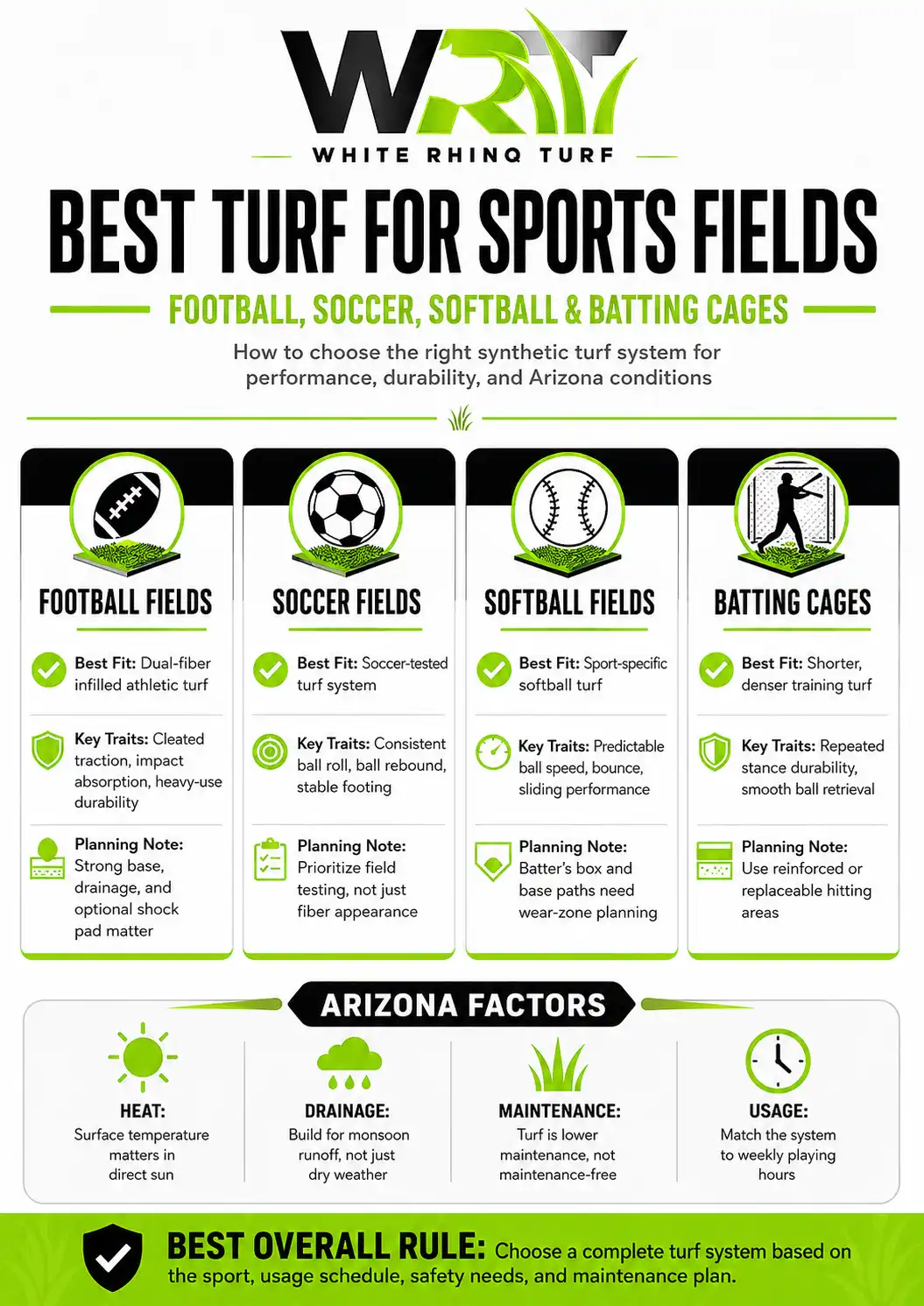
Football and soccer fields generally use longer-pile, infilled athletic turf designed to support cleated traction, repeated directional movement, impact absorption, and frequent use. Softball fields may combine different turf characteristics across the infield, outfield, warning areas, base paths, and high-wear zones. Batting cages usually perform better with a shorter, denser product that handles repeated foot traffic and allows balls to roll smoothly for easier collection.
A facility should not select athletic turf based only on how the sample looks or feels in a showroom. The product must be evaluated as part of a complete system that includes:
A premium carpet installed over an unstable or poorly draining base can still fail. Likewise, a durable turf product can become hard, uneven, or inconsistent when infill is not properly maintained. Athletic-field quality depends on how all parts of the system work together.
Before comparing turf brands, facility operators should define how the field will be used. A private training area serving one team has different needs from a high school stadium, municipal sports complex, indoor academy, or commercial facility hosting tournaments every weekend.
Document the following details before requesting proposals:
Field capacity is one of the main reasons organizations install synthetic turf. Natural grass needs time to recover from repeated practices, games, divots, wet conditions, and concentrated traffic. Synthetic turf can allow a facility to schedule more activities without waiting for the grass to recover, provided the field is maintained and not used outside the manufacturer’s guidelines.
More usable hours do not mean unlimited use. The owner still needs a maintenance program based on actual field traffic. A field shared by football, soccer, marching band, camps, and community events will require more frequent grooming, infill adjustment, cleaning, and inspection than a lightly used practice surface.
Football fields experience some of the most demanding conditions in athletics. Players accelerate, cut, tackle, fall, and push against the surface while wearing cleated footwear. Linemen repeatedly load the same areas, while sidelines, team boxes, goal lines, hash marks, and midfield sections can accumulate concentrated wear.
The best artificial turf for football fields is generally a tested, infilled athletic system designed for:
Many football field turf installations use a blended or dual-fiber system. These products combine upright monofilament fibers with slit-film or texturized support fibers.
Monofilament fibers are individual blades that generally provide a grass-like appearance, resilience, and consistent interaction with the athlete and ball. Slit-film fibers are broader fibers that split into a net-like structure as they wear. They can increase durability and help stabilize the infill.
A dual-fiber system attempts to balance these characteristics. The monofilament component supports appearance and recovery, while the supporting fibers help hold infill and tolerate repetitive traffic.
Nationally used examples include FieldTurf Vertex CORE, Shaw Legion, Sprinturf Predator, AstroTurf RootZone 3D3 Blend, Act Global Xtreme Turf DXF, and Hellas Matrix Helix. These names illustrate the types of systems used at schools, universities, stadiums, and multipurpose facilities, but the brand alone does not determine whether a product is suitable for a specific project.
Facilities considering an artificial turf football field installation should request documentation for the complete system, including the carpet, infill, base, drainage, pad, maintenance schedule, and field-testing requirements.
A football proposal should clearly state:
More aggressive traction is not automatically better. The surface needs to provide enough grip for acceleration and cutting while permitting appropriate rotational movement. Excessive rotational resistance may place additional stress on the lower extremities, while insufficient traction can cause slipping and reduced control.
The system should be evaluated with the sport, expected footwear, playing level, and testing standard in mind.
The visible turf is only the top layer of a football field. Much of the field’s drainage, stability, shock performance, and long-term consistency is determined below the surface.
A typical artificial football field may include:
The exact profile depends on native soil, field elevation, drainage outlets, climate, field design, and the selected turf system. The FIFA stadium design guidance describes the importance of a stable formation layer, drainage, permeable aggregate, separation layers, leveling, and optional shock-absorbing components.
The subgrade is the prepared soil beneath the field. It must be evaluated for stability, moisture conditions, and compaction. Weak or uneven subgrade conditions can contribute to settlement, low spots, surface irregularities, and drainage problems.
The aggregate layer creates a stable platform while allowing water to move through the field profile. The depth and gradation of the material should be engineered for the site rather than copied from a residential turf specification.
Drainage can include perforated pipe, collector drains, perimeter drains, and graded aggregate. A permeable turf backing does not solve drainage problems by itself. Water must be able to move through the turf, infill, base, and drainage network to an approved outlet.
A shock pad may be installed between the aggregate base and turf carpet. Depending on the product and field system, a pad can contribute to impact attenuation, drainage, and long-term performance consistency.
A shock pad does not eliminate the need for properly managed infill or routine testing. It should be selected as part of the complete field system.
The best turf for soccer fields must provide more than durability. Soccer depends heavily on the relationship between the surface, the ball, the footwear, and the athlete’s movement.
Important soccer performance characteristics include:
A product may be durable enough for football but still produce soccer ball speeds or rebounds that do not suit the desired level of play. Soccer facilities should therefore prioritize sport-specific testing rather than assuming any athletic turf will perform correctly.
Third-generation soccer systems typically use longer synthetic fibers with sand and performance infill. National product examples include AstroTurf LigaTurf, Sprinturf MXE, Act Global Xtreme Turf DX, and soccer-tested configurations from FieldTurf and Shaw Sports Turf.
The FIFA Quality Programme for Football Turf provides one recognized framework for evaluating laboratory and completed-field performance. FIFA testing considers factors such as ball behavior, athlete interaction, durability, and surface consistency.
Neither surface is universally better for every soccer facility.
Artificial turf may be advantageous for facilities that need:
Natural grass may be preferable when the facility prioritizes:
The decision should consider climate, water access, maintenance staffing, usage hours, competition requirements, and athlete expectations.
Softball fields have highly specific playing requirements. The surface affects how a ground ball travels, how it bounces, how athletes slide, and how players move between the infield, outfield, base paths, batter’s box, and warning areas.
The best softball field turf should be selected around:
Dedicated softball turf products are generally more appropriate than simply extending football turf across a diamond.
FieldTurf TripleThreat, for example, is designed around softball-specific ball speed, line, and bounce. Shaw B1K for Softball is also marketed as a sport-specific system that accounts for differences between the playing areas of a softball field.
These product families demonstrate an important point: the ideal field may not use one identical construction everywhere. The infield, outfield, batter’s box, bullpen, warning track, and transitions may benefit from different fibers, pile heights, infill levels, backing reinforcement, or replaceable panels.
Softball and baseball field operators frequently report that the highest-wear areas require attention before the rest of the field.
These areas include:
Facilities should ask whether localized sections can be replaced without removing the entire field. Replaceable hitting zones or reinforced panels can simplify future repairs and limit disruption.
Metal cleats, portable pitching equipment, batting mats, bases, maintenance machines, and temporary field features should all be discussed before installation. The manufacturer’s footwear and equipment guidelines should become part of the field-use policy.
Batting cages have different requirements from full-size athletic fields. A batting lane receives repeated traffic in a small number of locations, especially around the hitter, catcher, pitching machine, and entry area.
The best batting-cage turf is generally:
Long, heavily infilled turf can make loose balls harder to collect and may introduce maintenance needs that are unnecessary inside a narrow training lane. Shorter products allow balls to roll more predictably while still improving the appearance and usability of the space.
Indoor batting turf may be installed over concrete, a padded underlayment, or another prepared surface. The construction must account for player comfort, adhesive compatibility, moisture conditions, seams, and equipment movement.
A multipurpose indoor training facility that hosts baseball, softball, football, soccer, and general conditioning may need a more robust athletic system than a dedicated batting lane. The product should match the full range of activities rather than only the visual style of the space.
Outdoor installations need a stable base and functional drainage. Arizona UV exposure and surface temperature should also be considered. Hitting mats or replaceable turf panels can protect the primary stance area from accelerated wear.
The decision between artificial turf and natural grass should not be reduced to a claim that one is always better.
A useful comparison of artificial turf and natural grass sports fields should evaluate the facility’s operating needs, climate, playing schedule, maintenance capabilities, and athlete preferences.
The better option is the one that aligns with the facility’s actual use and operating resources.
Surface heat is one of the most important considerations for sports turf installation in Phoenix, Scottsdale, and surrounding Arizona communities.
Artificial turf can become substantially hotter than natural grass under direct sunlight. The Sports Field Management Association cites research showing that synthetic surfaces may reach very high temperatures during clear, sunny weather.
For Arizona facilities, heat should be addressed during product selection and field operations—not after the installation is complete.
Evaluate:
No artificial turf product remains cool in every Arizona condition. Products promoted as cooling systems may reduce temperatures relative to traditional configurations under certain conditions, but they do not eliminate solar heat gain.
Watering can temporarily reduce surface temperature, but the effect may be short-lived. A facility should not assume that occasional irrigation will make afternoon practices comfortable throughout the summer.
Morning, evening, and seasonal scheduling may still be necessary. Athletic departments should establish heat policies based on measured surface conditions, athlete age, exertion level, air temperature, radiant heat, and available shade.
Arizona’s dry climate does not eliminate drainage concerns. Intense monsoon storms can release large amounts of water over a short period, exposing weaknesses in the base, grading, seams, edges, and collection system.
Sports-field drainage should address:
Fine Arizona dust can also settle into the field and mix with the infill. Over time, contaminants may contribute to compaction, slower drainage, fiber matting, and uneven surface performance.
Facilities installing turf in high-traffic commercial areas should account for dust, foot traffic, equipment access, concentrated wear, and surrounding hardscape during the drainage design process.
One of the most damaging misconceptions about artificial turf is that it requires no maintenance.
Synthetic sports fields do not need mowing, fertilizing, or traditional grass recovery, but they still require routine attention.
Maintenance can include:
The frequency should be based on usage, not merely the age of the field. A heavily scheduled stadium or sports complex may need more frequent maintenance than a lightly used practice facility.
Arizona conditions add several local concerns:
Facility operators should create a documented maintenance program using the manufacturer’s requirements and an Arizona artificial turf maintenance guide as a starting point for local conditions.
Sports turf rarely wears evenly. Athletes and equipment concentrate traffic in predictable areas.
Football wear zones commonly include:
Soccer wear zones often include:
Softball and baseball wear zones include:
Batting-cage wear is concentrated around:
Ask the installer how these areas will be reinforced, maintained, and replaced. A field that allows localized panel replacement may be easier and less disruptive to repair than one requiring extensive carpet removal.
Sports-field proposals can look similar on the surface while including very different construction scopes.
One bid may include excavation, engineered drainage, a shock pad, independent testing, maintenance training, and removal of unsuitable soil. Another may quote only the turf carpet, infill, and basic installation.
Organizations planning commercial turf installation should compare each proposal line by line.
A guide to evaluating commercial turf installers can also help decision-makers compare experience, project scope, maintenance support, communication, and warranty responsibilities.
A single field can support multiple sports, but every additional use introduces design compromises.
A football and soccer field combination is common because both sports use a rectangular playing area and cleated footwear. Even so, football and soccer may have different preferences for pile construction, infill depth, traction, surface deformation, and ball behavior.
Multipurpose planning should address:
Trying to make one surface ideal for football, soccer, softball, field hockey, marching band, festivals, and playground activity may result in a field that is not ideal for any single application.
Recreational areas should also be evaluated separately from competitive sports fields. The impact attenuation, fall-zone design, drainage, and usage patterns associated with playground turf systems differ from the needs of a cleated athletic field.
Before selecting a product or installer, ask:
The best turf is a sport-specific system selected for the athletes, footwear, ball behavior, traffic level, climate, drainage, safety requirements, and maintenance capacity of the facility. Football, soccer, softball, and batting cages frequently require different turf constructions.
Football fields commonly use longer-pile, infilled polyethylene turf. Many modern systems combine monofilament and slit-film fibers to balance resilience, appearance, durability, and infill stability.
The best soccer turf is a tested system that provides predictable ball roll, ball rebound, traction, rotational resistance, shock absorption, and surface uniformity. Competitive facilities should evaluate soccer-specific testing rather than selecting generic athletic turf.
Artificial turf may be better for facilities needing high scheduling capacity and consistent field availability. Natural grass may provide lower surface temperatures and traditional playing characteristics. The right choice depends on usage, climate, maintenance resources, and athlete needs.
Artificial turf can support frequent practices, games, and tournaments, while natural grass may be preferred for cooler temperatures and traditional play. Neither surface is universally better for every soccer facility.
A football field may include compacted subgrade, geotextile fabric, a permeable aggregate base, drainage pipes, a leveling course, an optional shock pad, synthetic turf, and infill.
Not every system requires a separate shock pad. A pad may improve impact attenuation, drainage, and performance consistency, but it must be compatible with the turf and infill system.
Softball generally performs best on a sport-specific system designed around ball speed, line, bounce, sliding, traction, and high-wear areas. Different field zones may require different construction details.
Batting cages typically benefit from shorter, dense turf with strong backing, secure seams, predictable ball roll, and replaceable hitting areas. Outdoor cages also need a stable, well-draining base.
Artificial turf can become significantly hotter than natural grass under direct Arizona sunlight. Surface temperature varies with the turf, infill, air temperature, sun exposure, wind, moisture, and surrounding materials.
Yes. Sports turf may require debris removal, brushing, grooming, infill redistribution, decompaction, seam inspections, cleaning, repairs, and field testing. It is lower maintenance in some categories, but it is not maintenance-free.
Yes, but the field should be designed around a clearly defined primary sport and compatible secondary uses. Line markings, traction, ball behavior, goal anchoring, usage hours, and maintenance needs must be addressed during planning.
The best turf for sports fields cannot be identified by one product specification or brand name. It must be selected as a complete athletic system.
For football and heavily used multipurpose fields, a tested dual-fiber infilled system is often a strong starting point. Soccer facilities should prioritize ball behavior, traction, and soccer-specific field testing. Softball fields benefit from dedicated systems designed around speed, line, bounce, sliding, and replaceable wear areas. Batting cages usually need shorter, denser turf with reinforced hitting zones and simple ball retrieval.
Arizona facilities must also consider heat, UV exposure, dust, compacted soil, monsoon drainage, and seasonal scheduling. These local factors can significantly affect product selection, field design, maintenance, and athlete comfort.
The most reliable decision comes from comparing complete systems, understanding the tradeoffs, reviewing relevant testing, and selecting an installer capable of supporting the field after the final seam is secured.

White Rhino Turf delivers professional artificial turf installation in East Valley AZ and across Phoenix. From pet turf and putting greens to full backyard transformations, our licensed in-house crews complete most projects in two weeks or less—with warranties and financing that give homeowners peace of mind.