
- Home
- Locations
- Turf Installation
- Services
- About
- Recent Projects
- Blog
- Contact
Yes, artificial turf can drain water very effectively when the entire system is designed and installed correctly. Water typically passes through the turf backing and into a prepared aggregate base below, where proper grading helps move moisture away from the surface. The artificial grass itself, however, is only one part of that drainage system.
That distinction is especially important for Arizona homeowners. A synthetic lawn may need to handle sudden monsoon rainfall, water from surrounding landscaping, routine rinsing, pool splash, and, in pet areas, dog urine. Phoenix-area soil conditions—including hard, calcium-rich caliche layers—can create additional drainage challenges that need to be considered before turf installation begins.
White Rhino Turf installs artificial grass systems with drainage, site conditions, intended use, and Arizona weather in mind. Understanding how artificial turf drainage works can help homeowners choose the right turf and recognize when puddles, odors, soft spots, or slow drainage may indicate a larger installation problem.
Artificial turf does not drain exactly like natural grass. With a natural lawn, water enters the soil directly around the grass blades. Artificial turf is installed as part of a layered system designed to move water through the finished surface and into the materials underneath it.
A typical artificial turf installation may include:
Rain or rinse water first reaches the artificial grass surface. It then passes through drainage openings or permeable sections of the backing into the prepared base. From there, the base, grading, underlying soil, and any additional drainage infrastructure determine where that water goes next.
This is why professional artificial turf installation in Phoenix involves considerably more than rolling synthetic grass over an existing yard. Excavation, grading, base preparation, compaction, turf selection, and drainage planning can all affect how the finished system performs.
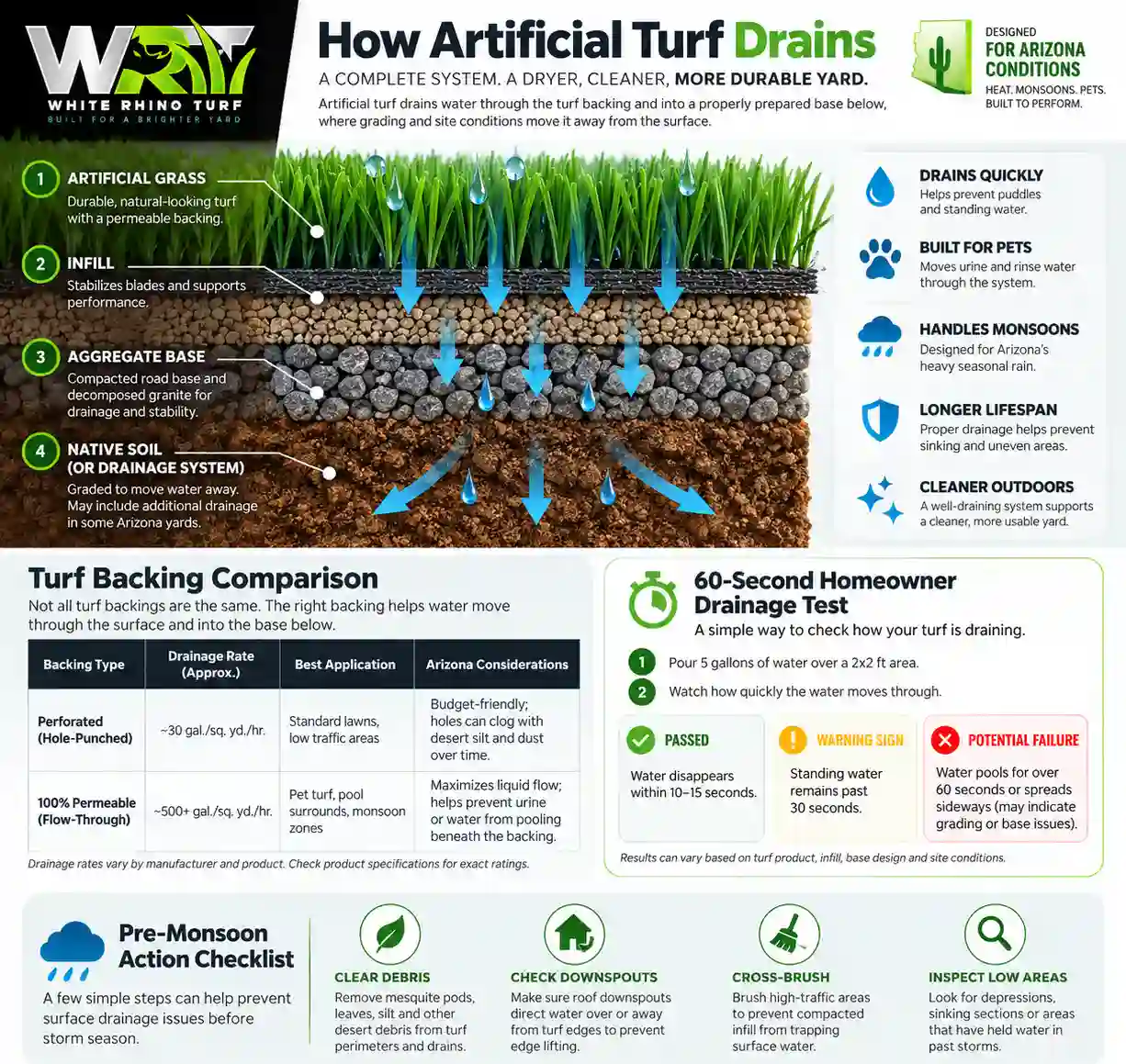
Yes. Landscape artificial grass is generally manufactured with a backing designed to let water pass through. However, not every turf product uses the same drainage design.
Two common approaches are perforated backing and fully permeable or flow-through backing.
| Backing Type | Approximate Drainage Capacity* | Common Applications | Arizona Considerations |
|---|---|---|---|
| Perforated (Hole-Punched) | Some products are rated around 30 gal./sq. yd./hr. | Standard residential lawns and lower-demand areas | Can provide adequate drainage for many applications, but drainage openings and the surrounding system need to remain clear of accumulated debris, silt, and other material. |
| 100% Permeable (Flow-Through) | Some products are rated at 500+ gal./sq. yd./hr. | Pet turf, high-drainage applications, pool surrounds and areas receiving frequent water | Allows liquid to pass through a much larger portion of the backing, making this style especially useful where rapid drainage is a priority. |
*Drainage ratings vary substantially by manufacturer and turf product. Product specifications should be checked for the artificial grass being considered rather than treating these figures as universal drainage rates.
Perforated turf typically moves water through regularly spaced drainage holes. A fully permeable backing allows liquids to pass through a much larger portion of the turf backing.
That distinction can be particularly relevant for pet turf. Dog urine and rinse water are concentrated in smaller areas of the yard, making efficient movement through the turf surface especially valuable.
However, installing a highly permeable turf product does not automatically create a well-draining yard.
The turf backing is only the first stage.
Once water passes through the artificial grass, it still needs somewhere to go. A 100% permeable turf installed over poor grading, a failing base, or problematic native soil can still experience drainage problems.
Some of the most important components of an artificial lawn are completely invisible once the installation is finished.
Existing natural grass, roots, debris, loose soil, and unstable material generally need to be removed before the new foundation is installed. Depending on the property and application, aggregate materials such as road base and decomposed granite may be used to create a stable foundation underneath the turf.
Proper base preparation helps:
Compaction is important as well. A poorly prepared base can settle after installation, potentially creating depressions where rainwater or rinse water begins collecting.
At the same time, drainage should not be reduced to simply choosing a particular aggregate or adding more infill. Turf backing, excavation, grading, base construction, compaction, native soil, and surrounding landscape conditions all influence the completed system.
Homeowners interested in how the material between the turf blades affects an existing lawn can also read our guide to artificial turf infill. Infill can influence turf performance, but replacing infill alone will not correct a failing base or improper grading underneath the lawn.
Water follows gravity, making grading one of the most important parts of artificial turf drainage.
Before turf is installed, the property should be evaluated to determine where water currently travels, where it enters the project area, and where it needs to go after passing through the artificial grass.
A yard that looks completely flat is not necessarily properly graded.
Subtle changes in elevation can help move water away from low areas and prevent it from collecting against the home, patio, retaining walls, or other structures.
The surrounding landscape matters too.
Patios, pools, pavers, walls, planters, roof downspouts, neighboring properties, landscape drains, and changes in elevation can all affect where water travels during a storm.
For example, a new paver area can change the amount and direction of runoff entering an adjacent artificial lawn. A downspout discharging directly against the turf edge can concentrate a large amount of roof runoff into one small area.
Artificial turf drainage therefore needs to be planned as part of the entire property rather than treating the synthetic grass as an isolated surface.
Arizona’s monsoon season is one of the best reasons to take artificial turf drainage seriously.
Phoenix can experience extended periods with very little rainfall followed by storms that deliver a large amount of water in a short period. A yard that appears to drain perfectly during routine rinsing can behave very differently under intense monsoon rainfall.
A properly designed turf system allows rainwater to move through the artificial grass and into the drainage system below. Grading, base preparation, native soil, surrounding landscaping, and any additional drainage components then determine how effectively that water leaves the area.
Monsoon storms can expose weaknesses that remain hidden during the rest of the year.
Potential warning signs include:
Temporary surface water during an unusually intense storm does not automatically mean the installation has failed. What happens after the rainfall stops is often more informative. Water that repeatedly remains in the same locations can indicate a grading, base, soil, or drainage issue worth investigating.
Arizona homeowners can also inspect their artificial lawn before monsoon season begins. A few basic steps can reduce preventable surface drainage problems and make existing issues easier to spot.
Yes. Artificial turf is not immune to flooding.
No landscape surface can guarantee that flooding will never occur when water enters an area faster than the property can manage it.
The drainage performance of artificial turf depends partly on factors outside the turf itself, including native soil, grading, surrounding hardscape, existing drainage infrastructure, neighboring runoff, and the volume of incoming water.
A highly permeable backing does not solve every property-level drainage problem.
For example, water flowing from a roof, patio, pool deck, and neighboring yard toward one low section of artificial turf may overwhelm that area even though the turf product itself allows water to pass through rapidly.
This is why evaluating the property before installation matters. Artificial grass needs to fit into the site’s overall drainage plan.
Water that briefly appears during a heavy storm is different from persistent puddles that repeatedly remain after surrounding areas have drained.
The location and behavior of the water can provide clues about where the problem originates.
| What You’re Seeing | Possible Cause | What to Check |
|---|---|---|
| Water sits directly on the turf surface | Debris, compacted material, clogged drainage openings, or slow movement through the surface | Inspect the turf fibers, infill, debris accumulation, and backing performance |
| The same small puddle appears after every rain | Low spot or localized base settlement | Check whether the finished surface has sunk or become uneven |
| Water moves sideways across the turf instead of downward | Slow drainage below the turf, grading problems, or problematic native soil | Evaluate the base, grade, soil conditions, and direction of runoff |
| Water collects around the turf perimeter | Edge grading, surrounding hardscape, or concentrated runoff | Inspect patios, pavers, curbing, downspouts, walls, and nearby landscape elevations |
| Turf feels soft or unstable after rain | Base movement, erosion, or water remaining beneath the installation | Evaluate the underlying foundation rather than treating only the surface |
| Pet areas drain slowly and develop recurring odor | Concentrated pet use, drainage limitations, contaminated infill, or underlying system problems | Assess both cleaning conditions and drainage beneath the turf |
| Large areas hold water after monsoon storms | Property-level grading, inadequate drainage capacity, base problems, or difficult native soil | A broader drainage evaluation may be necessary |
Persistent drainage issues in an older artificial lawn can indicate that the problem extends beneath the turf itself. Homeowners dealing with widespread sinking, poor drainage, persistent odors, aging turf, or repeated failures can learn more about turf replacement in Phoenix and how an existing base can be evaluated before new turf is installed.
Homeowners who suspect a drainage problem can perform a simple observational test to see how their turf responds to a concentrated amount of water.
This is a screening check, not a professional drainage test. Turf products, slopes, infill levels, base systems, soils, and drainage designs vary, so the timing below should be treated as a reason to investigate—not as a universal engineering standard.
Fast drainage: Water disappearing through the turf within roughly 10–15 seconds suggests the tested surface is accepting water quickly.
Warning sign: Visible standing water remaining after approximately 30 seconds may justify checking for debris, infill conditions, surface compaction, or slower drainage beneath the turf.
Potential drainage problem: Water remaining for a minute or longer—or visibly traveling sideways to another area instead of draining downward—can indicate a larger issue involving grading, the base, native soil, or the overall drainage design.
Repeat the observation in more than one area if necessary. One slow section may indicate a localized low spot, while similar behavior across a large portion of the lawn can point toward a broader drainage issue.
Arizona’s “hard dirt” deserves a more specific name in many Phoenix-area properties: caliche.
Caliche forms when calcium carbonate and other minerals bind soil particles together, creating extremely hard layers below the surface. In some areas, it can behave more like concrete than loose desert soil.
That matters for artificial turf because water passing successfully through the turf and aggregate base may eventually encounter native soil that absorbs water much more slowly.
Simply installing highly permeable artificial grass does not make an underlying caliche layer disappear.
Site conditions therefore need to be evaluated during excavation and base preparation. Properties with difficult drainage conditions may require a more deliberate drainage strategy. Depending on the site, that can involve addressing restrictive soil layers, adjusting excavation and grading, or incorporating drainage solutions such as appropriately designed drains or French-drain systems.
The appropriate solution depends on the individual property. A French drain is not automatically necessary for every Phoenix artificial turf installation, nor should every hard section of native soil be treated the same way.
The important point is that the installer needs to understand what is underneath the yard.
This is one reason two Phoenix backyards of identical size can require different preparation even when the homeowners choose the same artificial turf product.
Drainage becomes even more important when dogs regularly use an artificial lawn.
A typical residential yard primarily needs to manage rainfall, runoff, and occasional rinsing. Pet turf also needs to manage urine and the additional water homeowners use to rinse frequently used areas.
Pet-friendly turf products may use highly permeable backing to allow liquids to move through the artificial grass quickly. The layers underneath still need to support that drainage.
Without an effective path below the turf, urine and rinse water can remain within parts of the system rather than moving away appropriately. Over time, those conditions can contribute to persistent odors and make routine cleanup more difficult.
A pet turf system should therefore be selected and installed based on more than blade softness or appearance.
Important considerations include:
White Rhino Turf’s pet turf installation in Phoenix considers drainage and everyday pet use when planning artificial grass systems for dog-friendly Arizona yards.
Proper drainage can help reduce conditions that contribute to pet odors, but good drainage does not mean pet turf never needs to be cleaned.
Dog urine still contacts the turf fibers, backing, infill, and other components of the installation. Solid waste should be removed promptly, and pet areas require appropriate rinsing and cleaning.
The purpose of good drainage is to help liquids move through and away from the turf instead of remaining trapped in poorly draining areas.
Persistent odor can involve several factors, including:
For routine homeowner care, see our guide on how to clean and deodorize artificial turf in Arizona. White Rhino Turf does not offer cleaning or deodorizing as a standalone turf maintenance service; this resource is designed to help homeowners care for their existing artificial grass.
There is no single artificial turf product that is automatically the best choice for every Arizona property.
The appropriate drainage characteristics depend heavily on how the area will be used.
A decorative front lawn, heavily used backyard, dog run, pool surround, putting green, playground, and commercial landscape can each have different performance requirements.
For pet areas, highly permeable backing can be particularly valuable because urine and rinse water frequently enter concentrated sections of the lawn.
Homeowners comparing dog-friendly products can read our guide to the best artificial grass for dogs in Phoenix for additional information about selecting turf for pets.
But backing should never be evaluated in isolation.
A turf product capable of moving large quantities of water through its backing can still experience puddles if the base underneath has settled or the yard directs water toward a low point.
Infill plays an important role in an artificial turf system, but it is not the primary drainage system.
Depending on the product and application, infill can help:
Pet use and Arizona heat can also influence which infill products are considered for a project.
Over time, heavily trafficked areas can become matted or experience changes in infill distribution. Cross-brushing and appropriate homeowner care can help maintain the turf surface.
However, adding or replacing infill cannot correct an improperly graded yard, settled base, restrictive native soil, or failed drainage system underneath the artificial grass.
That distinction is particularly important when troubleshooting an existing installation. A problem originating several inches below the turf cannot necessarily be solved by treating the visible surface.
There is no single drainage time or gallons-per-hour figure that defines a properly functioning artificial lawn.
Manufacturers can provide drainage ratings for individual turf products, but those ratings describe how water passes through the turf itself under specific conditions. They do not guarantee that an entire backyard will manage water at the same rate.
The finished system also depends on:
Instead of focusing exclusively on a manufacturer’s drainage number, homeowners should pay attention to how the completed installation behaves.
After routine rinsing or normal rainfall, water should generally move away without repeatedly leaving persistent puddles in the same areas.
Arizona monsoon rainfall creates a much more demanding scenario, and temporary surface water during an intense storm should not automatically be interpreted as failure.
It can, but the drainage strategy needs to account for the soil beneath the installation.
Artificial grass should not simply be placed directly over hard native dirt and expected to drain correctly.
The installation area needs to be evaluated and properly excavated, graded, prepared, and compacted. Discovering a restrictive caliche layer can affect how water needs to be managed at that particular property.
Depending on site conditions, installers may need to address portions of the restrictive layer or incorporate additional drainage infrastructure that provides water with an appropriate path away from the turf area.
This is also why drainage problems should be diagnosed before assuming the artificial grass product is responsible.
Water may pass through the turf perfectly well and still encounter a problem underneath it.
Sometimes. The appropriate solution depends entirely on the cause.
A localized low spot is different from a yard experiencing widespread standing water after every monsoon storm.
Drainage problems can originate at several levels:
Identifying the source is important before assuming that adding infill, cleaning the turf, or making another surface-level adjustment will correct the issue.
An older artificial lawn showing widespread fading, damaged fibers, persistent odors, poor drainage, lifted edges, separated seams, or multiple sinking areas may need a more comprehensive evaluation.
In those situations, removing the old turf provides an opportunity to inspect the base and determine whether it can be reused, repaired, or rebuilt as part of a professional turf replacement.
Artificial turf longevity depends on product quality, UV exposure, pets, traffic, installation quality, drainage, and ongoing care.
The drainage system is particularly important because homeowners cannot easily see what is happening underneath the turf after installation.
A stable, properly prepared foundation helps the surface remain even and secure as the system ages. Poor drainage combined with base movement, erosion, or grading problems can contribute to visible problems at the surface.
Addressing those conditions during installation can therefore be just as important as choosing durable artificial grass.
For more information about expected longevity, read our guide explaining how long artificial turf lasts in Arizona.
Artificial turf in Arizona has to perform under conditions that extend far beyond occasional rain.
A complete installation may need to account for:
That is why choosing artificial grass based only on appearance or price can overlook important performance differences.
Heat is another major consideration. Artificial grass can become hot in direct Arizona sunlight, and turf construction, infill, shade, surrounding materials, and other factors can affect surface temperatures.
Our guide to artificial turf temperatures in Arizona explains what Phoenix homeowners should know about heat and cooling options before selecting a turf system.
Homeowners planning a turf project can learn much more by asking how the installer intends to manage water than by simply asking, “Does this turf drain?”
Useful questions include:
These questions shift the conversation from the artificial grass product to the complete installation system—which is where many long-term drainage problems are either prevented or created.
Yes. Landscape artificial turf generally allows water to pass through perforations or permeable sections of its backing. The finished yard’s drainage also depends on its base, grading, native soil, and surrounding landscape.
Rainwater passes through the turf backing into the prepared base. From there, grading, the underlying soil, and any additional drainage infrastructure help manage where the water travels.
Fully permeable turf can move liquid through a greater portion of its backing and can be useful for high-drainage applications such as pet areas. That does not automatically make it the best turf for every project. Intended use, product characteristics, base construction, site drainage, durability, appearance, and other factors should all be considered.
A properly designed artificial turf system should manage rainfall, but intense monsoon storms can place significantly greater demands on a yard than routine rinsing or light rain. Site grading, base preparation, caliche and native soil conditions, surrounding hardscape, and the amount of incoming runoff all affect performance.
Recurring puddles can result from surface debris, low spots, improper grading, base settlement, restrictive soil, drainage problems underneath the turf, or changes to the surrounding landscape. Persistent standing water should be evaluated to determine where the problem originates.
Pet-friendly artificial grass can use highly permeable backing that allows urine and rinse water to pass through the turf. The underlying base and drainage design must also provide a path for those liquids to move away effectively.
Caliche can restrict how quickly water moves into the native soil beneath an artificial turf installation. Its presence does not automatically mean a yard cannot have artificial turf, but the site conditions need to be considered during excavation, grading, base preparation, and drainage planning.
Not every artificial turf installation requires a French drain. Additional drainage infrastructure depends on the property’s grading, native soil, caliche conditions, runoff, surrounding landscape, and intended use. The appropriate drainage solution should be determined from the individual site rather than applied universally.
Poor drainage can contribute to conditions where moisture and pet waste remain within the turf system longer than intended. Pet odor can also involve infill, cleaning practices, concentrated pet use, and contamination within an older turf system, so drainage is one potential factor rather than the only cause.
Some drainage problems can be corrected, but the appropriate solution depends on the cause. Issues involving widespread base settlement, grading, restrictive soil, or failure beneath an aging installation may require more extensive work than a surface adjustment.
The best time to solve an artificial turf drainage problem is before the turf is installed.
A quality artificial lawn is a complete system. Turf backing determines how water gets through the artificial grass, but excavation, base construction, compaction, grading, native soil, caliche, and the surrounding landscape determine what happens to that water afterward.
Those details become particularly important in Arizona. A Phoenix yard can experience months of dry conditions followed by intense monsoon rainfall, while pet turf may need to manage urine and rinse water every day of the year.
Homeowners replacing an older installation have another opportunity to address these issues. Removing the existing turf can reveal whether persistent puddles, sinking, or odors originated in the turf itself or within the base and drainage system underneath it.
White Rhino Turf evaluates drainage conditions, existing landscaping, property use, sun exposure, pet activity, and other site-specific factors before installing artificial grass.
Learn more about artificial turf installation in Phoenix and how White Rhino Turf approaches site preparation, turf selection, drainage, and professional installation for Arizona properties.

White Rhino Turf delivers professional artificial turf installation in East Valley AZ and across Phoenix. From pet turf and putting greens to full backyard transformations, our licensed in-house crews complete most projects in two weeks or less—with warranties and financing that give homeowners peace of mind.