
- Home
- Locations
- Turf Installation
- Services
- About
- Recent Projects
- Blog
- Contact
Artificial turf can turn the space around your pool into a cleaner, greener, low-maintenance part of the backyard without the mud, mowing, or irrigation that comes with natural grass. White Rhino Turf installs artificial turf around pools in Phoenix with careful attention to drainage, sun exposure, foot traffic, surrounding hardscape, and the way the pool area connects to the rest of your outdoor space.
Poolside installations require more than choosing a turf product that looks good. Splash-out, monsoon rain, intense Arizona sun, existing concrete or travertine, elevation changes, and transitions between materials all affect how the finished area performs. Our team plans the turf system around those site conditions so the finished installation looks intentional and functions as part of the entire backyard.
Poolside turf installations can include:
White Rhino Turf serves homeowners throughout Phoenix and the surrounding Valley with professional turf installation completed by our in-house crews.
Upgrade your yard with a team you can trust—done right, done clean, and built to last. Transparent pricing delivered within 24 hours. No pressure, no hidden fees.
Tell us about your yard--get transparent pricing in 24 hours.
"*" indicates required fields

Poolside artificial turf needs to perform differently from a standard lawn installation. Around a swimming pool, the surface is exposed to frequent splash-out, wet foot traffic, direct sun, surrounding hardscape, and runoff from patios or pool decks. That makes drainage, base preparation, edging, and turf selection especially important.
White Rhino Turf installs artificial turf in Phoenix with the full site in mind rather than treating the turf as an isolated surface. Around pools, we evaluate how water moves across the property, how the turf connects to concrete, pavers, or travertine, and how much sun and foot traffic the area receives.
The best poolside turf layout depends on the property itself. Some Phoenix backyards benefit from a larger turf area beside the pool, while others work better with turf used between hardscape sections, along a pool perimeter, or as part of a combined turf-and-paver design.
Natural grass can be difficult to maintain next to a pool in Phoenix. Constant sun exposure, foot traffic, splash water, irrigation, and frequent trimming can leave the area muddy, patchy, or harder to keep clean. Artificial turf creates a more predictable poolside surface while still giving the backyard a softer, landscaped appearance.
Artificial turf helps reduce the loose soil and grass debris that can get tracked from landscaped areas onto the pool deck and into the water. There is also no mowing or string trimming beside the pool, which means fewer clippings around coping, patios, and surrounding hardscape.
Poolside turf can turn an unused strip of dirt or natural grass into a more functional part of the backyard. It can be incorporated into lounge areas, play spaces, pathways, seating zones, or larger landscape sections beside the pool.
Artificial grass does not require the routine watering needed to maintain a natural lawn. For Phoenix homeowners, that can simplify landscaping around the pool and eliminate sprinklers that may otherwise spray onto decking, furniture, windows, or the pool itself.
A backyard made entirely of concrete, pavers, or stone can feel visually heavy. Artificial turf introduces a green landscape element that can soften the transition between the pool, patio, walkways, and the rest of the yard.
Artificial turf can be cut and installed around curves, borders, hardscape edges, landscape beds, and other custom features. This makes it useful for both large poolside lawns and smaller areas where turf is being added between existing materials.
For homeowners planning a broader backyard redesign, turf can also be combined with pavers, travertine, and other hardscape features to create a pool area that feels connected rather than pieced together.
Drainage is one of the most important parts of a poolside turf installation. Water around a swimming pool does not come from one source alone. Splash-out, rinsing, rain, runoff from nearby patios, and Arizona monsoon storms can all move across the same area, so the turf system needs a clear path for that water to travel.
Artificial turf itself is only one part of the drainage system. Water typically moves through the turf backing, into the infill and prepared aggregate base, and then follows the grading and drainage conditions beneath the installation.
A permeable or perforated turf backing can allow water to pass through the surface, but that does not guarantee the entire yard will drain correctly. The prepared base, slope, native soil, nearby hardscape, and existing drainage patterns all affect what happens after water reaches the ground below.
White Rhino Turf evaluates these site conditions before installation so the poolside turf is designed around the property rather than relying on the turf backing alone.
Concrete pool decks, pavers, travertine, patios, and retaining features can redirect water toward the turf. Low spots or poorly planned transitions may cause runoff to collect in areas that otherwise appear well drained.
Poolside turf installation may require careful grading around:
Phoenix yards can receive large amounts of water during short, intense storms. A pool area that drains normally after routine splash-out may behave very differently during a monsoon, especially where surrounding hardscape concentrates runoff into the turf.
Proper base preparation and grading help create a more reliable drainage path, but every property is different. Compacted native soil, restrictive soil layers, existing elevations, and the amount of water entering the area all need to be considered.
For a deeper explanation of how backing, base preparation, grading, soil, and runoff work together, read our guide to how artificial turf drainage works.
It can. Artificial turf exposed to direct Phoenix sun may become hot during the summer, which is especially important around a pool where people are often barefoot. The goal is not to pretend the surface never heats up, but to plan the installation around how the space will actually be used.
Poolside turf temperatures can be influenced by several factors, including the amount of direct sunlight, the turf fiber design, blade color, infill, surrounding hardscape, and the presence of shade from structures or landscaping.
Sun exposure matters most. Areas that receive intense afternoon sun can heat up more than sections shaded by the home, patio cover, trees, or other structures.
The turf product also matters. Different fiber shapes, densities, pile heights, and colors can perform differently under direct sunlight.
Infill can influence performance. The type of infill used helps support the turf fibers and can affect how the system behaves in hot conditions.
Nearby materials can change the overall environment. Concrete, pavers, travertine, block walls, and other hardscape surfaces can all contribute to heat around the pool area.
Poolside turf should be selected for the way the space is used. A narrow decorative strip may have different requirements than a larger area used for lounging, kids, pets, or regular barefoot traffic.
No artificial turf product should be assumed to stay comfortable for bare feet during the hottest parts of a Phoenix summer. Shade, layout, and product selection all play a role, and homeowners can also cool the surface with water before use when temperatures are high.
White Rhino Turf considers sun exposure and intended use when helping homeowners choose turf for pool areas. That can be especially important in wide-open backyards with little afternoon shade or in spaces where the turf will be used frequently throughout the day.
For a deeper look at surface temperatures and ways to manage heat, read our guide to how hot artificial turf gets in Arizona.

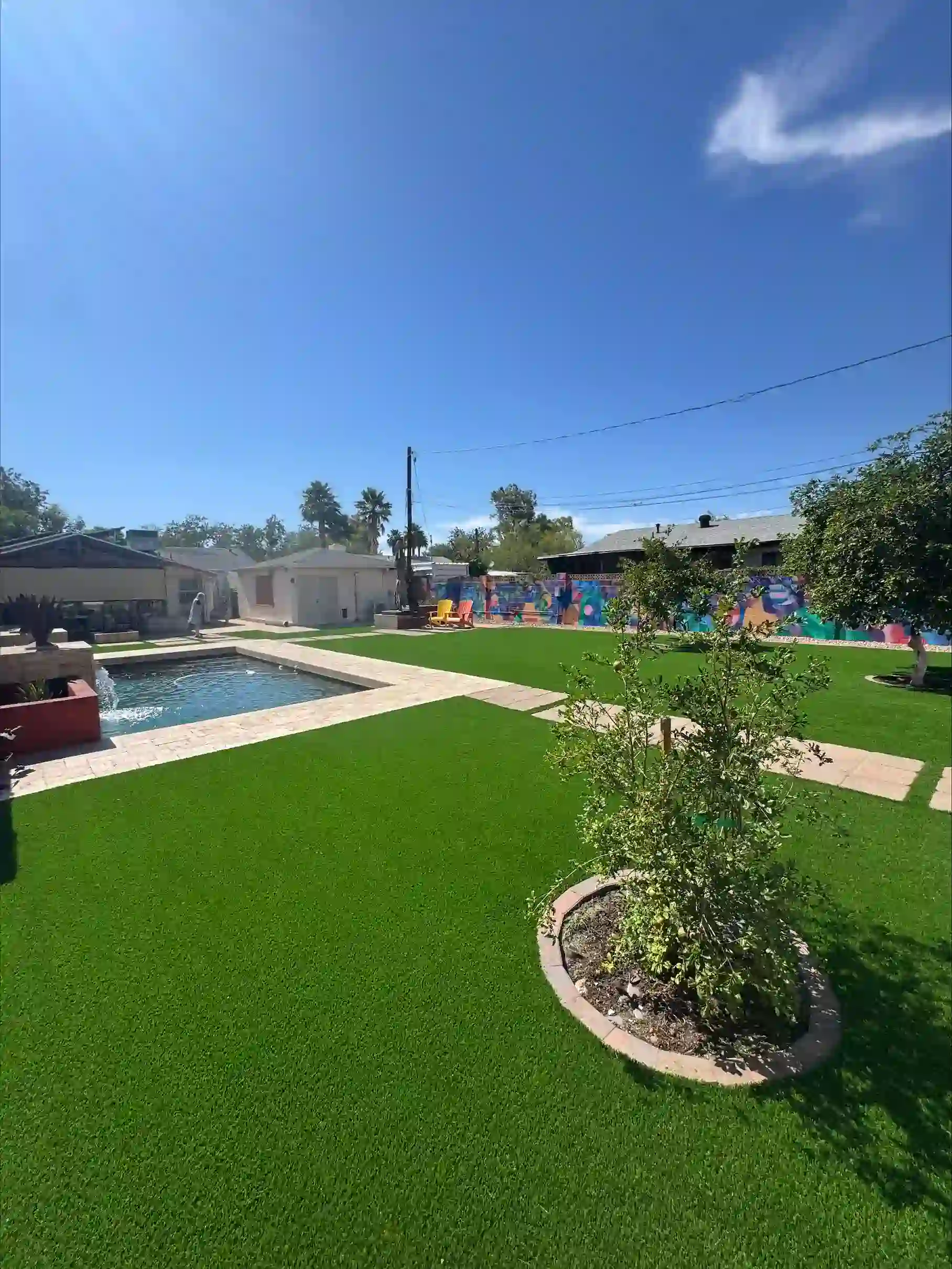
Pool Deck and Artificial Turf
An existing pool deck can transition directly into a larger turf area for lounging, recreation, or open backyard space. Proper elevation and edging help create a clean boundary between the two surfaces.
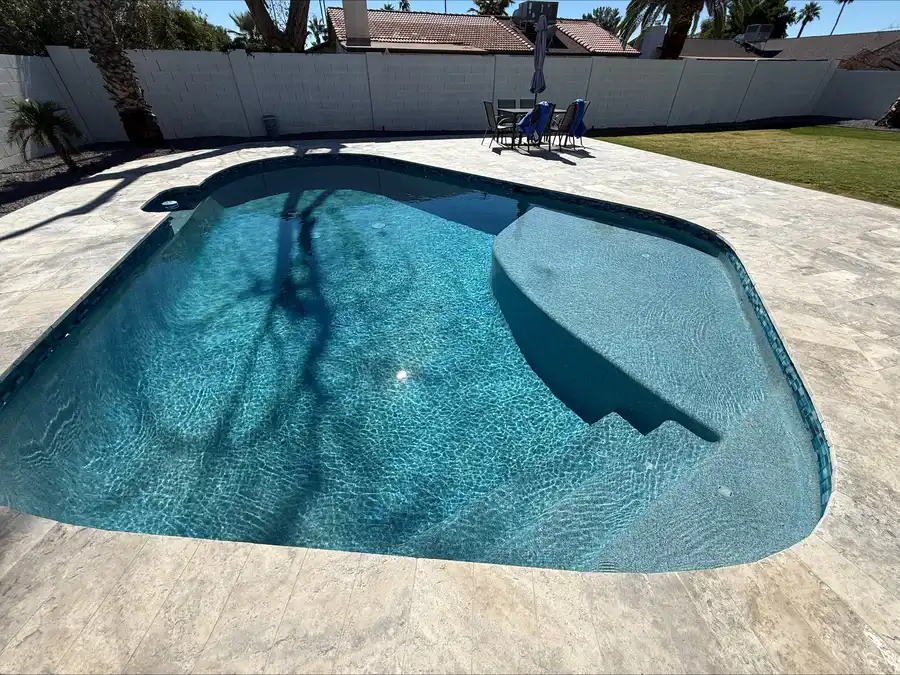
Pavers and Turf
Pavers can be incorporated as borders, patios, pathways, or individual stepping pads surrounded by artificial grass. This gives homeowners the durability of hardscape without covering the entire backyard in a solid surface. Explore our paver installation services for additional poolside and backyard options.
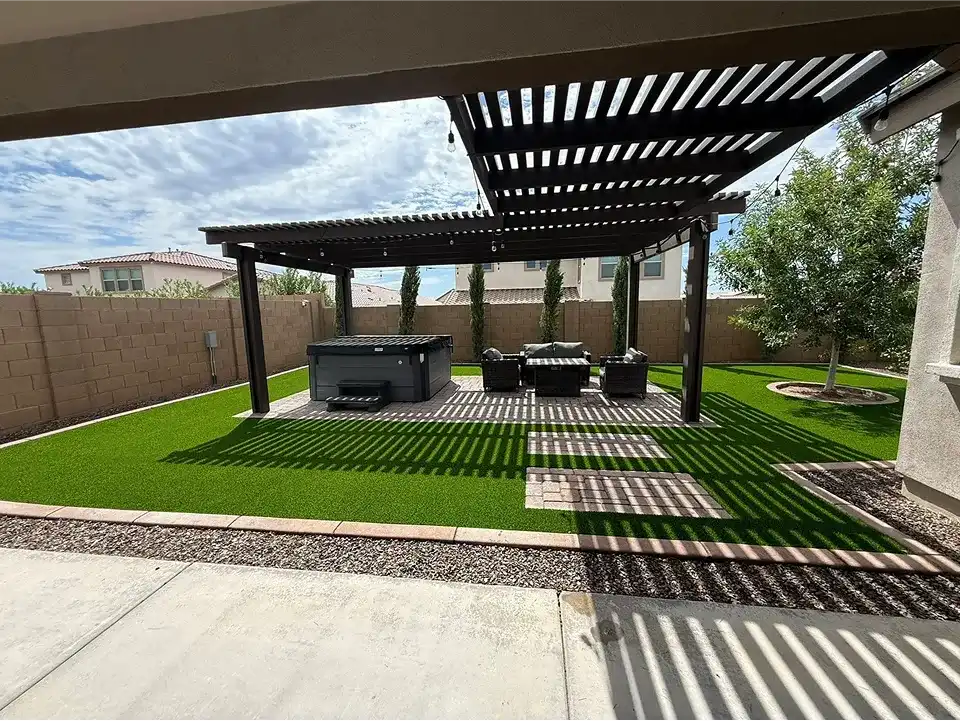
Travertine and Turf
Travertine is commonly used for pool decks and surrounding outdoor living areas. Artificial turf can extend beyond the stone to create a softer landscape transition or fill designated spaces between hardscape features. Learn more about our travertine installation services.
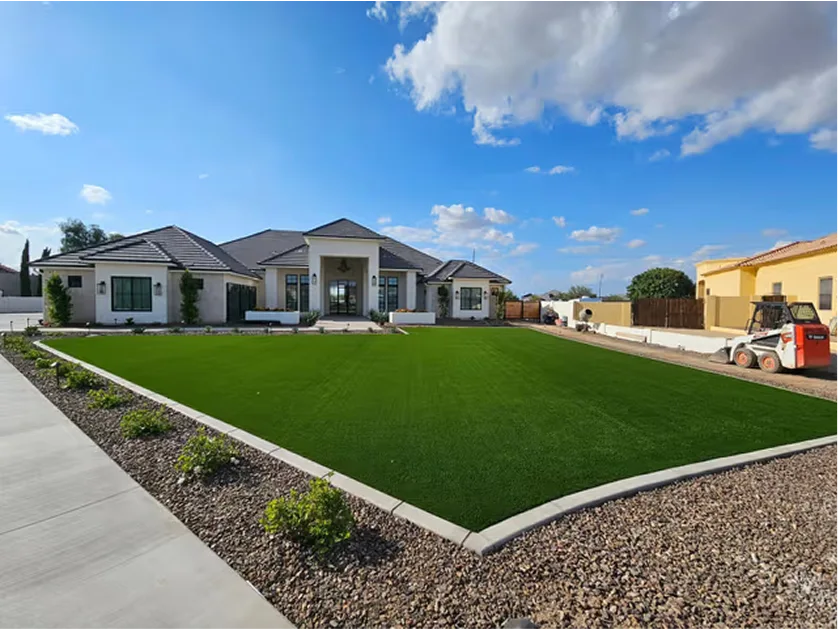
Turf Strips and Custom Borders
Artificial grass can also be installed in narrower areas between pavers, patios, landscape borders, or other backyard features. Curved cuts allow the turf layout to follow existing pool shapes and custom hardscape designs.
The best artificial turf for a pool area is not necessarily the thickest or most expensive option. Poolside turf needs to match the way the space is used, how much sun it receives, how water moves through the area, and what materials surround it.
For Phoenix homeowners, White Rhino Turf looks at the entire poolside environment before recommending a turf system.
| Feature | Why It Matters Around a Pool |
|---|---|
| Permeable backing | Helps water move through the turf surface after splash-out, rinsing, or rainfall. |
| Durable fibers | Pool areas can see frequent foot traffic from kids, guests, pets, and everyday backyard use. |
| Appropriate pile height | Affects appearance, feel, maintenance, and how the turf performs in active areas. |
| UV performance | Direct Arizona sunlight places additional stress on outdoor materials. |
| Stable backing and edges | Helps the turf remain secure where it meets concrete, pavers, travertine, or landscape borders. |
| Compatible infill | Supports the turf fibers and can influence drainage, use, and heat-related performance. |
A decorative turf strip beside a pool deck may not need the same characteristics as a larger section used for recreation, outdoor furniture, or pets. Sun exposure, traffic level, drainage conditions, and surrounding hardscape should all influence the final selection.
For example, a pool area used heavily by dogs may require more emphasis on drainage and odor control, while an open west-facing yard may place greater importance on heat-related product characteristics and shade planning.
There is no single “best” pool turf for every Phoenix backyard. The right choice is the product that fits the site, the drainage plan, the amount of sun, and how the homeowner intends to use the space.
That site-specific approach helps prevent a common mistake: choosing artificial grass based on appearance alone and only later discovering that it does not match the conditions around the pool.
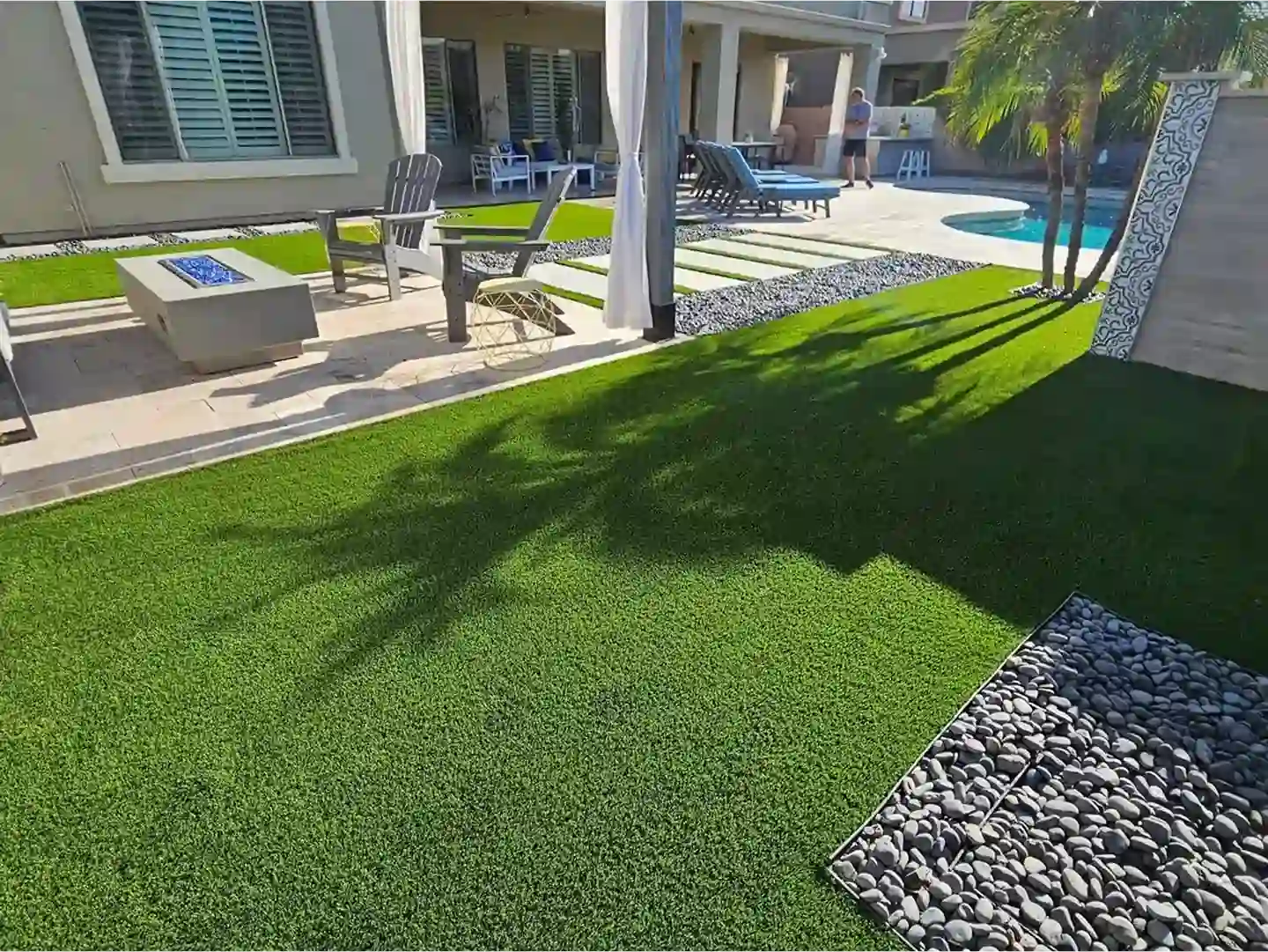
Artificial turf can work well around both chlorinated and saltwater pools, but the turf product still needs to be appropriate for outdoor poolside use. Normal residential splash-out is very different from exposing turf to concentrated pool chemicals, so product specifications and manufacturer care guidelines matter.
Routine splash water from a properly maintained chlorinated pool is generally not a problem for quality outdoor synthetic turf. The larger concern is usually what happens around the turf: repeated wetting, drainage, residue, and how the area is cleaned over time.
Saltwater systems still use chlorine, but they generate it differently. Poolside turf can be installed beside these systems as long as the selected product is suited for the environment and the surrounding area drains properly.
Undiluted chlorine, shock treatments, acids, algaecides, and other concentrated pool chemicals should not be poured or mixed directly on artificial turf. Spills should be handled according to the turf manufacturer’s instructions and the directions on the pool chemical itself.
This is one reason White Rhino Turf considers the intended use of the area before installation instead of treating every backyard with the same turf specification.
Artificial turf has a textured fiber surface, but no material around a swimming pool should be described as completely slip-proof. Wet conditions, standing water, footwear, surface contamination, and the transition between turf and neighboring hardscape can all affect traction.
A well-planned installation focuses on:
For pool areas, drainage and surface stability are closely connected. Keeping water moving through and away from the turf helps create a more usable space after swimming, cleaning, or summer storms.
Artificial turf can do more than replace a patch of grass beside the pool. In many Phoenix backyards, it works best as part of a larger design that combines green space, hardscape, seating, walkways, and other outdoor living features.
The layout should be based on how the area is actually used. Some homeowners want a larger turf section for kids and pets, while others prefer smaller turf zones that soften the look of pavers, travertine, or concrete.
A larger turf area beyond the hard pool deck can create a natural transition into the rest of the yard. This works well for open play space, casual seating, or simply breaking up a backyard dominated by hard surfaces.
Large-format pavers or stepping stones can be installed within the turf to create walkways between the pool, patio, outdoor kitchen, side yard, or other backyard features. This gives the area more structure without turning it into a fully paved space.
Travertine can define the main pool deck while artificial turf creates a softer perimeter around it. This combination is useful when homeowners want a finished poolside surface along with additional green space for lounging or recreation.
Narrow artificial grass strips can be used between pavers to add contrast and soften the overall design. These layouts require precise cuts and secure edges so the turf stays clean and intentional-looking over time.
A dedicated turf section can create a more flexible area beside the pool for families who want space for kids, pets, or backyard activities. Drainage and product selection become especially important when the same area sees frequent foot traffic and pet use.
Artificial turf can also be paired with rock, masonry, planters, lighting, and drought-conscious landscaping to create a backyard that still feels green without relying on a large natural lawn.
Design around how the backyard functions. The best poolside layout is not necessarily the one with the most turf. A balanced combination of turf, hardscape, shade, seating, and landscaping often creates a more usable outdoor space.
For more inspiration, explore our artificial grass and paver design ideas or see additional artificial turf backyard ideas for Phoenix homes.
Installing artificial turf around a pool requires careful planning before the turf ever goes down. Existing hardscape, drainage patterns, elevations, sun exposure, and the shape of the pool can all influence how the area should be prepared and finished.

We start by looking at the entire installation area, including the pool deck, existing landscaping, drainage, access points, surrounding hardscape, and how the homeowner plans to use the space. We also identify where turf will meet concrete, coping, pavers, travertine, walls, or landscape borders.
This gives us a plan for the turf layout before excavation begins and helps determine which turf characteristics make the most sense for the property.
Existing grass, soil, rock, or other unsuitable material is removed as needed before the base is prepared. The area is then graded and compacted to create a stable foundation for the turf.
Around a swimming pool, this stage is particularly important. We consider how splash-out and rain move off nearby hardscape so water has a planned route through and away from the turf area rather than collecting in low spots.
The turf is positioned, cut, joined, and secured to fit the planned layout. Pool areas often require more detailed cuts because of curved decks, paver borders, landscape beds, narrow sections, and other existing backyard features.
Special attention is given to transitions where artificial grass meets the pool deck or surrounding hardscape. Proper elevations and secure edges help create a finished installation that feels integrated with the rest of the backyard.
After the turf is secured, the appropriate infill is applied and distributed throughout the fibers. The turf is then groomed to help the blades stand naturally and create a consistent finished appearance.
Before completing the project, our crew inspects seams, edges, transitions, elevations, and the overall installation. We also review basic care considerations with the homeowner so they know how to keep their new poolside turf looking its best.
Artificial turf does not need to replace every surface around a swimming pool. In many Phoenix backyards, the best design uses different materials for different parts of the space.
Hardscape is generally better suited for structured walking areas, furniture, dining spaces, and the primary pool deck. Artificial turf works well where homeowners want a softer green surface, a recreational area, or a transition between the pool and the rest of the yard.
Poolside turf can work well for:
Pavers are a strong option for patios, pathways, seating areas, and other spaces where homeowners want a defined hard surface. They can also be combined with artificial turf to create borders, stepping paths, or mixed-material backyard layouts.
Travertine is commonly used for pool decks and surrounding hardscape because of its natural appearance and ability to create a more finished outdoor living area. It can transition directly into turf where homeowners want both a structured pool deck and softer landscaped space nearby.
In many projects, the answer is not turf or hardscape—it is both. Turf, pavers, and travertine can be planned together so each material is used where it makes the most sense.
Homeowners who are primarily looking to replace, resurface, expand, or redesign the hard surface around their swimming pool can learn more about our pool deck remodeling services in Phoenix.
For turf-focused projects, White Rhino Turf can help determine where artificial grass fits best around the existing deck, patio, landscaping, and other backyard features.
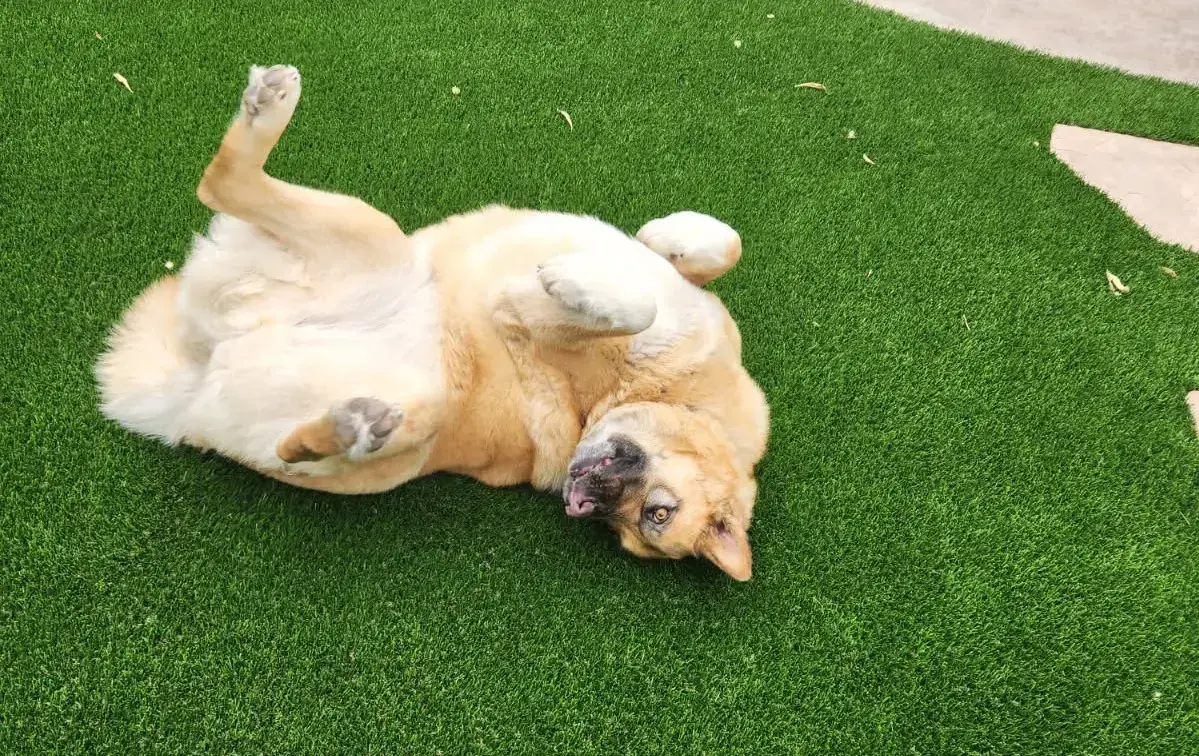
Poolside turf can be a practical option for households with dogs, but pet use adds another layer of planning to the installation. Drainage, infill, turf backing, and how easily the area can be rinsed all become more important when the same space is used for swimming, lounging, and pets.
Drainage becomes even more important. The turf needs to handle both pool splash-out and pet urine without allowing moisture to remain trapped in the system.
Odor control should be considered during product selection. Pet-friendly infill and a properly prepared base can help support a cleaner, easier-to-maintain surface over time.
The area should be easy to rinse. Poolside turf that also functions as a pet area benefits from convenient access to water and a drainage path that can handle routine rinsing.
Traffic patterns matter. Dogs often follow the same routes between doors, patios, pools, and shaded areas. Those high-use paths should be considered when choosing turf and planning seams or transitions.
Pool turf and pet turf do not have to be separate spaces. A well-planned system can serve both purposes as long as drainage, odor control, durability, and maintenance are considered from the beginning.
Solid waste should be removed promptly, and areas used for urination should be rinsed as needed. Leaves, dust, and other debris can be brushed or blown from the turf so they do not accumulate around the fibers or migrate toward the pool.
White Rhino Turf does not provide standalone turf cleaning or deodorizing services, but we can help homeowners select and install a turf system that is better suited for regular pet use.
For more information about drainage, infill, odor control, and turf selection for dogs, explore our pet turf installation services in Phoenix.
Poolside artificial turf needs to do more than look good on installation day. It has to work with the pool deck, surrounding hardscape, drainage, sun exposure, foot traffic, pets, and the rest of the backyard.
White Rhino Turf approaches these projects as part of the full outdoor environment rather than treating the turf as a standalone surface.
Our team evaluates how the turf will connect to concrete, pavers, travertine, patios, walls, and landscape features before installation begins. That helps us plan cleaner transitions, appropriate elevations, and drainage paths that make sense for the property.
White Rhino Turf uses in-house crews for our installations, giving us greater control over site preparation, base work, turf placement, seams, edging, infill, and the final finish of the project.
Pool projects often involve multiple materials. White Rhino Turf also installs pavers, travertine, landscaping, masonry, and other outdoor features, which can make it easier to coordinate a backyard where the turf needs to work alongside existing or newly installed hardscape.
Phoenix pool areas deal with intense sun, seasonal monsoon rain, compacted soils, dust, and heavy outdoor use. We account for those local conditions when planning the turf system, base preparation, drainage, and product selection.
White Rhino Turf also offers:
Our goal is to create a poolside turf installation that fits the property, performs well in the intended space, and looks like it belongs with the rest of the backyard.
Ready to replace natural grass, dirt, or unused landscaping around your pool? White Rhino Turf can design an artificial turf installation that works with your existing pool deck, drainage, pavers, travertine, and the rest of your backyard.
Our team will evaluate the space, discuss how you plan to use it, and recommend a turf system and layout suited for your Phoenix property.
Licensed & ROC-certified
In-house installation crews
Poolside turf, pavers & travertine
Financing options available
Product & labor warranty coverage
Request Your Free Artificial Turf Estimate
Or call (602) 694-7873 to talk with White Rhino Turf about artificial turf around your pool.
Tell us about your yard--get transparent pricing in 24 hours.
"*" indicates required fields

White Rhino Turf delivers professional artificial turf installation in East Valley AZ and across Phoenix. From pet turf and putting greens to full backyard transformations, our licensed in-house crews complete most projects in two weeks or less—with warranties and financing that give homeowners peace of mind.