
- Home
- Locations
- Turf Installation
- Services
- About
- Recent Projects
- Blog
- Contact
A well-designed dog run gives your dog a dedicated place to exercise, play, relax, and take bathroom breaks without taking over the entire backyard. In Phoenix, however, an outdoor dog run needs more planning than a simple fenced strip of ground. Extreme heat, intense sunlight, compacted soil, airborne dust, limited natural shade, and long dry periods can all affect how comfortable and clean the space remains.
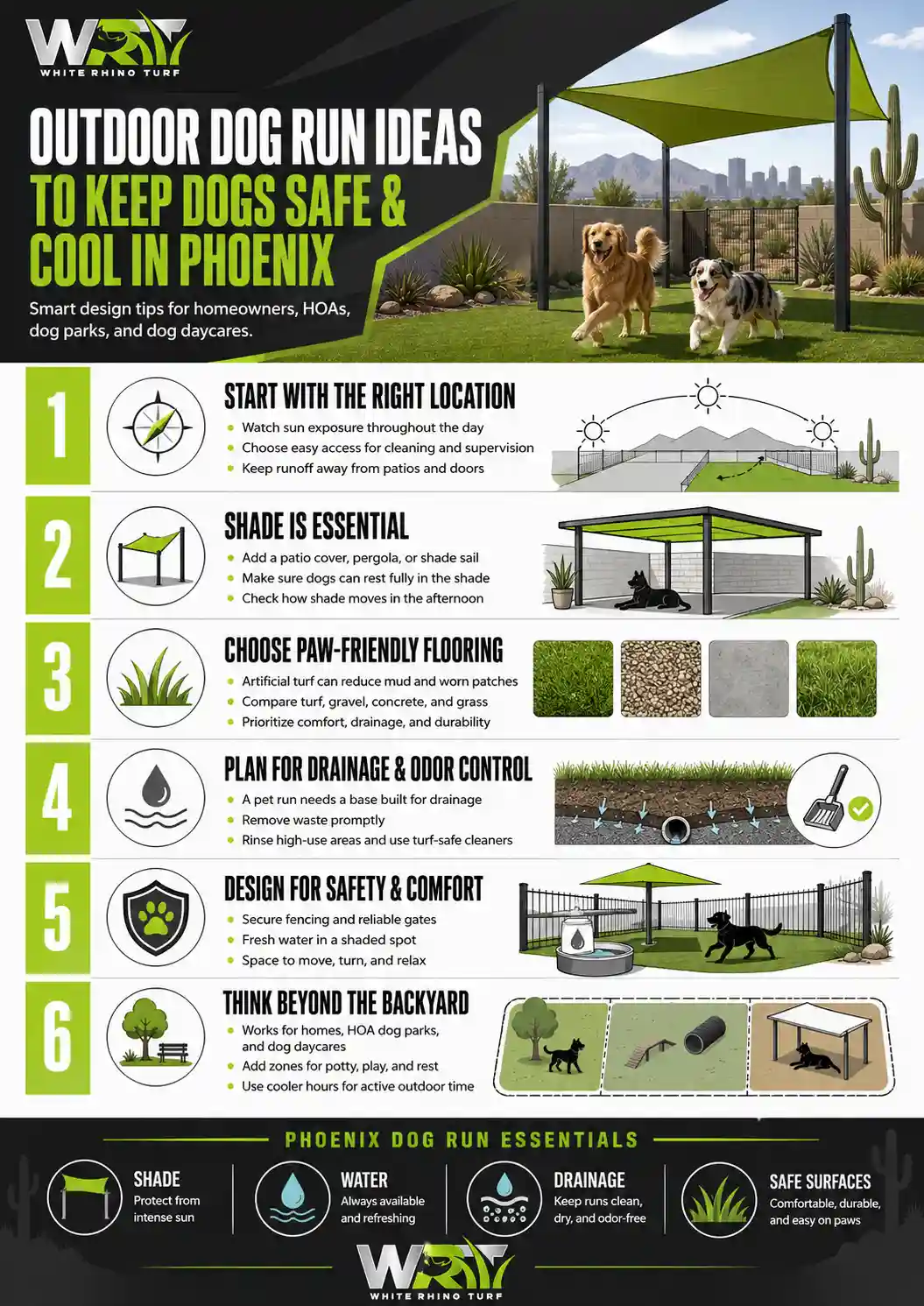
The best outdoor dog run ideas for Arizona focus on more than appearance. A functional design should provide dependable shade, fresh water, secure fencing, proper drainage, paw-friendly flooring, and enough room for the dog to move comfortably. It should also be easy for the owner, HOA, dog daycare, or property manager to inspect and clean.
Artificial turf can be a practical dog run flooring option when the complete system is planned for pet use. The turf surface, drainage layer, base preparation, infill, surrounding materials, shade coverage, and cleaning routine all work together. Turf alone cannot solve poor drainage, eliminate the need for maintenance, or make an uncovered area comfortable during the hottest part of a Phoenix summer day.
This guide covers outdoor dog run ideas for homeowners, dog owners, HOAs, dog parks, multifamily communities, and dog daycare facilities. It explains how to select a location, compare flooring materials, plan for heat and odor, and create a dog run that fits the way the property will actually be used.
A dog run is a defined outdoor area where dogs can move, play, rest, and relieve themselves while remaining within a controlled boundary. It may be a narrow run along the side of a house, a fenced section of a backyard, a shared HOA pet area, or a larger commercial dog run serving a daycare or boarding facility.
Some dog runs are primarily used as potty areas. Others are long enough for running and exercise. A large outdoor dog run may include separate play, rest, hydration, and waste areas. The right layout depends on the number of dogs, their size and activity level, how long they will use the space, and who will be responsible for cleaning it.
A dog run should not be treated as a substitute for walks, supervised exercise, indoor cooling, or regular interaction. It is best viewed as one part of a broader pet-friendly property design.
The goal is not simply to fence in an unused corner. A successful dog run is intentionally planned around animal comfort, safe access, drainage, cleanup, and Arizona heat.
In Phoenix, direct sunlight can quickly warm artificial turf, concrete, pavers, gravel, and other exposed surfaces. A dog run that feels comfortable in the early morning may feel very different later in the day. Shade patterns also move as the sun changes position, which means an area shaded at 8 a.m. may be fully exposed by early afternoon.
Before choosing a location, observe the property at several times of day. Pay attention to walls, fences, trees, rooflines, patio covers, and nearby buildings. West-facing areas may receive intense late-day sun, while enclosed spaces between block walls can experience limited airflow.
White Rhino Turf provides additional information about how hot artificial turf gets in Arizona and why shade, surface testing, and responsible use remain important even when pet-friendly products are selected.
Dogs should never be left outside simply because the run has a roof, turf, or water bowl. A roof can create shade, but a poorly ventilated enclosure may still trap heat. Fresh water can also become warm or contaminated if it sits in the sun. The dog’s comfort and behavior should always determine whether the space is appropriate to use.
The best location balances convenience, shade, drainage, security, and access. It should be easy enough to reach that the owner will actually clean and inspect it regularly. It should also avoid placing waste runoff near doors, patios, neighboring properties, play equipment, pools, or outdoor dining spaces.
A convenient location usually performs better than an isolated one. When a dog run is difficult to access, owners may postpone waste removal, rinsing, grooming, or inspection. For commercial facilities, staff routes and cleaning efficiency should influence the layout from the beginning.
An outdoor dog run attached to the house is one of the most convenient residential layouts. It can connect to a back door, laundry room, mudroom, side gate, or enclosed patio. This arrangement makes supervised access easier and can reduce the distance pets travel through the main yard.
The run may extend along the side of the home or occupy a fenced section near the rear patio. A dog door can provide direct access, but it should not be treated as permission for unrestricted outdoor use during hot weather.
When placing an outdoor dog run attached to a house, the base should be graded so water moves away from the structure. The doorway transition should also be secure and easy to clean. Avoid leaving gaps where turf edges meet concrete, pavers, or door thresholds.
A side yard is often the first place homeowners consider for a dog run because it is narrow, separate from the main entertaining area, and already bordered by a house wall and property wall. It can work well for bathroom breaks, controlled outdoor access, and linear movement.
However, Phoenix side yards can become heat corridors. Block walls, stucco surfaces, and limited airflow may create an uncomfortable environment. Before using the area, determine whether it receives morning sun, afternoon sun, reflected heat, or year-round shade.
A very narrow strip may work as a potty lane but may not provide enough room for meaningful exercise. Owners should distinguish between a relief area and a true exercise run when planning the size.
An outdoor dog run with a roof can provide dependable shade and make the area more usable throughout the year. Roofing options may include a patio extension, solid shade structure, pergola, canopy, or other approved cover.
The roof should be selected based on the property, available airflow, drainage, visibility, and local requirements. A solid roof blocks direct sun more consistently but may trap warm air if the enclosure has poor ventilation. A slatted cover allows more airflow but may not provide full shade throughout the day.
A covered dog run should still include an open-air route or indoor retreat. Shade makes the space more comfortable, but it does not make extended outdoor exposure appropriate during dangerous heat.
There is no single correct dog run size. The appropriate dimensions depend on whether the run is used for bathroom breaks, short periods of supervised outdoor time, or active exercise. Dog size, age, mobility, behavior, and the number of dogs all matter.
A small outdoor dog run may be suitable for a small dog that primarily needs a clean relief area. A large outdoor dog run should provide enough length for larger or more active dogs to move naturally without constantly turning around.
It is often more useful to think about zones than a single total square footage. A good layout may include a movement lane, a shaded resting area, a hydration point, and a designated waste area. Even a compact run can feel more functional when those uses are organized intentionally.
Outdoor dog run flooring affects heat, cleanliness, drainage, odor, traction, and long-term maintenance. No material is perfect in every situation. The right choice depends on the site, climate exposure, use level, and cleaning plan.
Natural grass can feel comfortable when healthy and shaded, but concentrated dog traffic often creates worn areas. Urine, digging, repeated running, limited sunlight, and Arizona water demands can make it difficult to maintain in a confined dog run.
Dirt is inexpensive but can produce dust during dry weather and mud after irrigation, rinsing, or rain. It may also become compacted and uneven under repeated use.
Gravel drains well in some applications, but loose stone can shift, scatter, and collect waste. Some gravel becomes uncomfortable underfoot or hot in direct sun. Small material may also stick between paw pads.
Concrete is durable and easy to hose, but it can become extremely hot and may feel hard underfoot. Proper slope and drainage are necessary to prevent standing water and waste accumulation.
Wood products offer a softer appearance but can scatter, break down, retain moisture, and require periodic replacement. Dogs may also chew or dig in the material.
Rubber flooring varies widely by product and application. Heat, drainage, odor retention, seams, and cleaning requirements should be evaluated before using it in an exposed Phoenix dog run.
An artificial turf dog run provides a consistent surface without the mud, bare patches, and mowing associated with natural grass. Pet-oriented turf systems can be designed around drainage, frequent rinsing, waste removal, and heavy foot traffic.
Artificial turf still requires shade, routine maintenance, and proper installation. Buyers should evaluate the entire system rather than choosing turf based only on blade color or softness.
Pet turf is not simply ordinary landscape turf placed inside a fence. An artificial turf dog run should be designed around urine drainage, solid-waste cleanup, concentrated traffic, odor management, and paw comfort.
White Rhino Turf discusses broader considerations for pet-friendly turf in Arizona, including how product selection and installation choices affect the way a pet area performs.
Some dog owners focus heavily on whether turf contains a specific cooling or odor-control feature. These details can matter, but they should not distract from base preparation and drainage. A premium surface installed over an unsuitable base can still develop problems.
Drainage is one of the most important parts of any artificial turf dog run. Pet urine, rinse water, rainwater, and cleaning solutions must have somewhere to go. Turf backing may allow liquid to pass through, but the soil and base underneath must also accept and redirect it.
Compacted Arizona soil can drain slowly in some yards. Low spots may collect water beneath or around the turf. Walls, concrete borders, and nearby patios can further restrict runoff.
A professionally prepared base helps create stable footing and allows water to move through the system. In some situations, additional drainage features may be appropriate. The solution should be based on actual site conditions rather than a standard assumption that perforated turf backing alone will solve every drainage issue.
There is no single product that makes an exposed outdoor dog run cool throughout a Phoenix summer. The most effective approach combines shade, timing, hydration, airflow, surface checks, and responsible limits on outdoor activity.
Shade sails, patio covers, pergolas, trees, umbrellas, and roof extensions can reduce direct sunlight. The shaded area should be large enough for every dog using the run to rest without crowding.
Do not assume that a shaded morning area will remain shaded in the afternoon. Track the space during the hours it will be used most often.
Use stable bowls or hydration stations that are difficult to tip. Position them in the shade and refresh the water regularly.
An elevated outdoor dog bed allows airflow underneath and gives the dog an alternative to lying directly on the ground.
A light rinse can temporarily reduce surface temperature. It should not be treated as a permanent cooling solution, and the area should drain before dogs use it for extended play.
Early morning and evening are generally more practical for active outdoor play than the middle of the day. Surface conditions should still be checked because hardscape and turf can retain heat.
A roof or privacy wall should not fully seal the space. Air needs to circulate, especially in narrow side yards and commercial enclosures.
The safest outdoor dog run design includes an easy route to a cooler indoor environment. Dogs should never be forced to remain outside because the run is fenced or shaded.
Before letting a dog onto the run, check the surface in several locations. Test both sunny and shaded areas, especially near walls, borders, and hardscape transitions. Concrete edging, pavers, metal thresholds, and gravel may feel hotter than the main turf area.
Surface conditions can change quickly as shade moves. A comfortable area may become warmer within a short period. Owners should continue monitoring the dog rather than relying on a single test at the beginning of outdoor time.
Move the dog indoors when the surface or air temperature is uncomfortable. Outdoor structures, turf systems, and cooling accessories do not replace attentive supervision.
Odor is usually a system and maintenance issue rather than a problem caused by one material alone. Urine can accumulate when the base drains poorly, the turf is not rinsed, solid waste remains too long, or the wrong cleaning product is used.
For more focused guidance, review White Rhino Turf’s article explaining how to remove pet odor from artificial turf.
High-use commercial spaces may require a written daily and weekly cleaning schedule. The cleaning plan should reflect the number of dogs, size of the run, weather, and how often the area is used.
A consistent routine is easier than waiting until the dog run develops a noticeable odor or visible buildup. Cleaning frequency will vary, but waste removal should always be prompt.
Do not assume that rain will fully clean a pet turf system. Phoenix rainfall is irregular, and a short storm may move dust without adequately flushing concentrated pet areas.
One of the most useful outdoor dog run ideas is dividing the space into functional zones. A designated bathroom area can make cleanup more predictable and reduce the amount of turf that receives concentrated urine.
The potty zone may use the same pet turf system as the rest of the run or a different suitable material. The best approach depends on drainage, dog preference, heat, and maintenance requirements.
Transitions between materials should be secure and easy to clean. Avoid loose edges, narrow gaps, and raised borders that may create trip hazards.
Fencing should reflect the dog’s size, jumping ability, digging behavior, and reaction to outside activity. A decorative low fence may work for a calm small dog but may be unsuitable for a large or highly motivated dog.
For shared dog parks and commercial facilities, a double-gate entry can help reduce accidental escapes. Separate entrances may also help staff manage dogs with different temperaments or activity levels.
Inspect fences and gates regularly. Soil movement, repeated impacts, weather exposure, landscaping work, and chewing can all create new openings over time.
Plants can soften the appearance of a dog run and provide partial shade, but they should be placed carefully. Dogs may chew leaves, dig around roots, or urinate near planting beds. Thorny, toxic, or easily damaged plants should not be placed within reach.
Plantings outside the enclosure are often easier to protect. They can screen fencing without becoming part of the dog’s play area. Drip irrigation should also be inspected for exposed tubing that dogs may chew or pull.
Artificial greenery or decorative screens may be used in some designs, but they should also be secured and evaluated for chew risk.
A dog run should offer more than an empty rectangle when space allows. Simple enrichment can encourage movement, exploration, and mental stimulation.
Every item should be appropriate for the dog’s size and behavior. Equipment should not block the main travel path, interfere with drainage, or create hidden areas that are difficult to clean. In Phoenix, dark plastic and metal components should be checked for heat before use.
A multi-dog run requires more space, more shade, and more careful supervision. Dogs may compete for water, beds, toys, or access to the gate. A layout that works well for one dog may feel crowded when two or more dogs are added.
Long, narrow runs can encourage fast chase behavior, so the design should match the dogs using the area. In some settings, two connected zones may be safer and easier to manage than one large open enclosure.
An HOA dog run serves a wider range of dogs and owners than a private backyard. The design must account for frequent use, varying dog sizes, resident behavior, waste management, accessibility, and ongoing maintenance.
Resident education matters as much as construction. Even a well-built dog run can develop odor or cleanliness problems when owners do not remove waste or when the community lacks a maintenance plan.
HOAs considering a shared pet area may also review commercial turf installation considerations for frequently used common spaces.
Dog daycare and boarding facilities place heavier demands on flooring and drainage than most residential yards. Multiple dogs may use the area throughout the day, increasing waste, hair, traffic, and cleaning frequency.
Commercial groups should also plan for downtime when sections need deeper cleaning or repair. Modular zones can allow one area to remain closed while another stays available.
The artificial turf dog run should be designed around the facility’s actual cleaning process. Staff should not need to drag hoses across occupied play areas, move heavy equipment repeatedly, or direct runoff through primary entrances.
An unused side yard may seem convenient, but it may receive direct western sun and reflected heat. Observe conditions before committing to the location.
Perforated turf backing cannot compensate for a poorly graded or impermeable base. Drainage should be evaluated at the property level.
A small doghouse or umbrella may not shade enough area for safe movement and rest. Shade should account for the number of dogs and changing sun angles.
Solid overhead cover should be paired with ventilation. Enclosing every side may restrict airflow.
A narrow strip can work for bathroom access but may not allow larger dogs to turn, run, or pass one another comfortably.
A beautiful design becomes difficult to maintain when there is no nearby hose, waste bin, drain path, or storage location.
Unsecured turf edges, flexible plastic edging, and exposed landscape fabric may invite chewing or digging.
Pet turf reduces mowing and mud, but it still needs waste removal, rinsing, grooming, and periodic deeper cleaning.
Water bowls should remain shaded, stable, and easy to refill.
A shaded dog run is still an outdoor environment. Phoenix heat requires active supervision and reasonable limits.
A dog run installation should begin with the way the space will be used, not with a turf sample. The installer should evaluate drainage, access, shade, dog activity, cleaning practices, and surrounding landscape conditions.
For residential projects in the Phoenix area, White Rhino Turf provides more information about pet turf installation in Phoenix. Scottsdale property owners can also review considerations for pet turf installation in Scottsdale.
The installation details should reflect those answers. A lightly used residential relief area and a busy dog daycare should not be approached as identical projects.
The best flooring depends on the property, shade, drainage, use level, and maintenance plan. Pet-friendly artificial turf is a popular option because it provides a consistent surface without mud or worn natural grass. It must still be installed over a suitable base and paired with shade and regular cleaning.
Artificial turf can become hot in direct sunlight, as can concrete, gravel, pavers, and other outdoor surfaces. Shade, rinsing, airflow, cooler usage times, and surface checks can help manage conditions. Dogs should have access to water and a cooler indoor area.
An outdoor dog run attached to the house can be convenient for supervision, bathroom breaks, and cleaning access. The design should direct water away from the foundation and account for reflected heat from walls.
Yes, provided the area has enough room, drainage, ventilation, and shade. Side yards can become very hot, especially when surrounded by block walls or exposed to western sun.
A roof is not always required, but dependable shade is essential in Phoenix. A roof, pergola, shade sail, patio cover, or mature tree canopy may provide shade. Covered spaces should remain well ventilated.
There should be enough shade for every dog to rest comfortably without crowding. Because shade moves, coverage should be evaluated during the hours the run will be used.
The run should allow the dog to stand, turn, walk, and move comfortably. Larger and more active dogs need more length. Multiple dogs require additional room, resting areas, and water access.
A narrow run may provide space for bathroom breaks and limited movement, but it may not replace walks or larger exercise areas. Owners should match the layout to the dog’s actual activity needs.
The base typically includes excavated and prepared material designed to create stability and drainage. The exact system should be selected based on soil, slope, runoff, and site conditions.
Urine passes through openings in the turf backing into the prepared base below. The base and surrounding grade must allow liquid to disperse rather than collect beneath the turf.
Odor may develop when waste remains on the surface, urine is not rinsed, drainage is poor, the base stays wet, or cleaning products are ineffective. A regular maintenance routine and appropriate installation system can reduce these problems.
Frequency depends on the number of dogs, weather, run size, and how concentrated the bathroom area is. Solid waste should be removed promptly, and urine areas should be rinsed as needed rather than waiting for odor to appear.
High-pressure cleaning can disturb infill, fibers, seams, or secured edges when used incorrectly. Follow the turf manufacturer’s care guidance and use methods appropriate for the installed system.
Do not apply household chemicals without confirming they are appropriate for the turf, infill, drainage system, pets, and surrounding landscape. Use products intended for pet turf and follow their directions.
The best infill depends on the turf system, heat exposure, odor concerns, drainage, and product compatibility. The infill should be selected as part of the entire installation rather than as an isolated add-on.
Separating the areas can simplify cleanup and reduce concentrated waste across the full dog run. It is especially useful in large residential runs, HOA dog parks, and commercial facilities.
Dogs may attempt to lift exposed or poorly secured edges. Proper perimeter attachment, stable transitions, and professional installation can reduce accessible areas where digging begins.
Gravel may drain well but can shift, become hot, scatter, and collect waste. Artificial turf offers a more consistent surface but requires base preparation and cleaning. The best option depends on the site and dog.
Concrete is durable and washable, but it can become hot and feels harder underfoot. If used, it should have proper slope, shade, and a plan for runoff.
Natural grass may work in lightly used, well-irrigated areas. Concentrated pet traffic, urine, digging, shade, and Phoenix water requirements can make it difficult to maintain in smaller runs.
The best fence depends on the dog’s height, strength, jumping ability, digging behavior, and response to outside activity. The gate and bottom edge are just as important as the fence material.
A double-gate entry can be helpful for HOA dog parks, dog daycares, multifamily communities, and households concerned about escapes. It creates a transition area between the run and the surrounding property.
Yes, provided the equipment is stable, appropriately sized, and positioned away from gates and fences. Materials should be checked for heat before use.
Place water in full shade, use a stable container, refresh it regularly, and check its temperature. Do not rely on a bowl that has been sitting outside for hours.
Yes. The project should be designed for frequent use, shared maintenance, drainage, waste removal, shade, accessibility, and resident rules. Commercial-use conditions require more planning than a private backyard.
Dog daycares should consider capacity, cleaning frequency, group separation, staff access, drainage volume, shade, water stations, repair access, and how sections will be closed for deeper cleaning.
Yes. A defined run can concentrate bathroom use and repeated foot traffic in one planned area, helping reduce worn paths, digging, and waste throughout the rest of the landscape.
No. A dog run provides convenient outdoor access, but dogs still benefit from walks, supervised activity, training, mental stimulation, and interaction.
A dog should not be left outdoors simply because the area has shade, water, or turf. Phoenix temperatures can become dangerous, and conditions should be monitored closely. Dogs need access to an appropriate indoor environment.
Start with a site evaluation. Review the dog’s needs, available space, sun exposure, drainage, access, fencing, cleaning routine, and surrounding landscape before selecting the turf or flooring.
The best outdoor dog run ideas combine practical design with responsible pet care. A successful space should be secure, shaded, easy to clean, properly drained, and appropriate for the dogs using it. Flooring is only one part of that system.
For homeowners, an artificial turf dog run can create a defined area without the mud, worn paths, and irrigation demands associated with a small natural-grass enclosure. For HOAs, dog parks, and dog daycare facilities, turf can provide a consistent surface that supports an organized maintenance plan.
Before installing a dog run, evaluate how the space feels throughout the day, where water will go, how waste will be removed, and whether every dog can reach shade and fresh water. These decisions have a greater effect on long-term performance than choosing a product based on appearance alone.
With thoughtful planning, a dog run can become a useful part of the property rather than an isolated enclosure. It can support daily routines, protect other outdoor areas, and give dogs a dedicated place to move and relax during appropriate weather conditions.

White Rhino Turf delivers professional artificial turf installation in East Valley AZ and across Phoenix. From pet turf and putting greens to full backyard transformations, our licensed in-house crews complete most projects in two weeks or less—with warranties and financing that give homeowners peace of mind.