- Home
- Locations
- Turf Installation
- Services
- About
- Recent Projects
- Blog
- Contact
Artificial turf is designed to provide years of dependable use, but even a well-installed synthetic lawn will not last forever. Daily foot traffic, pets, direct sunlight, drainage problems, shifting soil, worn infill, and Arizona’s intense summer heat can gradually affect how the turf looks and performs.
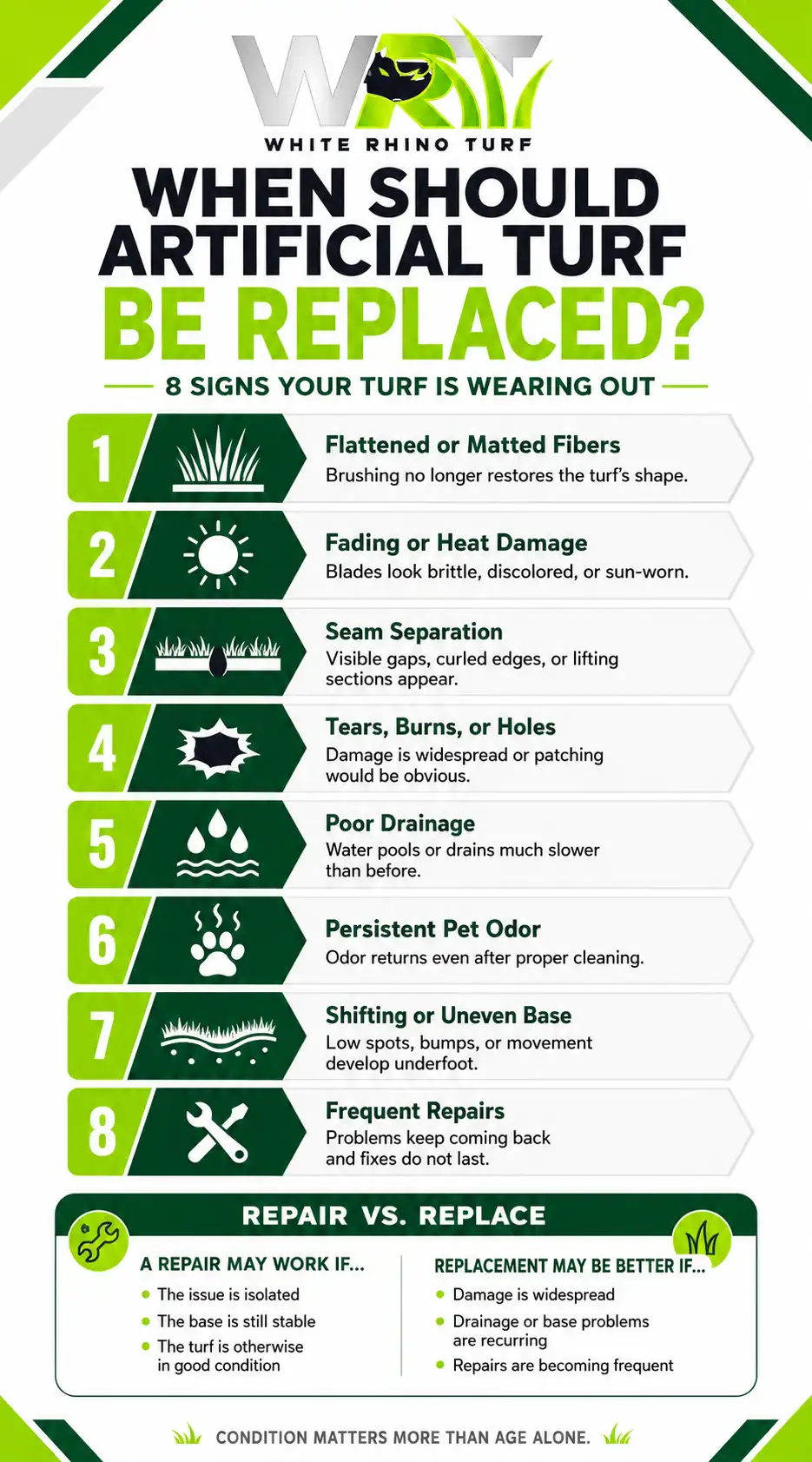
The difficult part is knowing whether an aging artificial lawn needs a minor repair, a deeper correction beneath the surface, or complete artificial turf replacement. A flattened area may only need brushing and additional infill. A small damaged seam may be repairable. However, widespread fiber wear, recurring drainage problems, persistent pet odors, or a failing base may indicate that replacing the turf is the more practical long-term solution.
Most artificial turf should be evaluated based on its condition rather than its age alone. A newer lawn with poor drainage or inadequate base preparation may develop serious problems early. Meanwhile, high-quality turf that was installed correctly and cared for properly may continue performing well beyond its original warranty period.
This guide explains eight signs your artificial grass may need to be replaced, which problems can often be repaired, what happens during turf removal and replacement, whether the existing base can be reused, and which factors can affect artificial turf replacement cost in Arizona.
High-quality residential artificial grass can often remain functional for approximately 15 to 20 years when it is properly selected, installed, and cared for. Actual results vary based on product quality, installation methods, sun exposure, foot traffic, pet use, drainage, infill selection, and the condition of the material beneath the turf.
Budget turf products may show wear earlier, particularly when installed in areas receiving full afternoon sun. Premium residential turf made with strong, UV-stabilized fibers generally provides better resistance to fading and fiber breakdown. However, even premium artificial grass experiences gradual wear when exposed to repeated use and Arizona’s desert climate.
Pet areas and frequently used walkways may wear faster than decorative sections that receive little traffic. Artificial grass in apartment dog parks, backyard dog runs, playgrounds, commercial properties, and active family yards may also require replacement sooner than turf installed primarily for appearance.
Age can provide helpful context, but it should not be the only factor in your decision. An artificial lawn that is ten years old and still drains properly, remains secure, and has resilient fibers may have several useful years remaining. A five-year-old installation with separated seams, standing water, contaminated infill, and significant base movement may already require extensive correction.
For a more detailed explanation of product quality, environmental conditions, usage, and expected service life, read our guide on how long artificial turf lasts in Arizona.
No. Old artificial turf does not automatically need to be removed simply because it has reached a certain age. The decision should be based on safety, appearance, drainage, stability, cleanliness, and whether the individual components of the turf system are still performing correctly.
An artificial turf installation is more than the visible green surface. It is a complete system that may include excavated soil, a compacted aggregate base, drainage improvements, edging, weed protection, turf backing, seams, fasteners, infill, and the synthetic fibers themselves. One component can fail while the others remain usable.
For example, low infill does not necessarily mean the entire lawn needs replacement. Additional infill and professional brushing may restore blade support if the turf fibers are still healthy. A single seam may sometimes be resecured if the backing and surrounding material remain strong. Localized damage may also be corrected with a carefully matched patch.
Complete artificial grass replacement becomes more likely when damage is widespread, the backing is deteriorating, the base is unstable, the surface creates safety concerns, or repairs repeatedly fail. Replacement may also make sense when correcting the existing system would cost nearly as much as installing a new one.
Artificial grass blades are designed to remain upright with support from the fiber structure and surrounding infill. Over time, repeated walking, running, playing, furniture placement, pet traffic, and exposure to heat can cause the fibers to flatten.
Some matting is normal in heavily used areas. Paths between a patio and side gate, spaces near a pool, pet routes, playground landing areas, and sections beneath outdoor furniture commonly show wear before the rest of the yard.
Brushing the turf against the direction of the fibers may help restore its appearance. Adding the correct amount of infill can also provide support and help blades remain upright. These steps are most effective when the fibers are still flexible and structurally sound.
Replacement may be appropriate when the blades remain permanently flat after brushing and infill correction. Worn fibers may lose their ability to return to an upright position. The surface can begin to look thin, shiny, uneven, or carpet-like rather than resembling natural grass.
Look closely at the difference between low-traffic and high-traffic areas. If the fibers in one section are substantially shorter, smoother, or more compressed than the surrounding turf, the material may be nearing the end of its useful life.
Flattening alone does not always justify replacing the entire lawn. A professional evaluation can determine whether the issue comes from insufficient infill, compacted infill, improper blade direction, ordinary wear, or permanent fiber damage.
Artificial turf installed in Arizona must withstand prolonged UV exposure and extremely high surface temperatures. Quality products are manufactured with UV protection, but the fibers and backing can still age after years of direct sunlight.
Gradual, even color change may be cosmetic. More serious warning signs include irregular fading, visibly bleached areas, brittle blades, cracking backing, excessive shedding, or fibers that break when handled.
Heat damage can also occur when concentrated sunlight reflects from certain windows or shiny surfaces. Reflected heat may create localized sections where fibers curl, shrink, flatten, or partially melt. Hot objects, fire features, charcoal, cigarettes, and equipment can cause similar damage.
A small melted area may sometimes be patched if matching turf is available. Widespread UV deterioration or brittleness is different. Once the material itself has degraded, cleaning and grooming cannot restore its original strength or color.
Faded turf does not always need immediate replacement if it remains secure and functional. However, brittle fibers and damaged backing may continue deteriorating. Replacement should be considered when the surface is shedding, cracking, creating bare spots, or no longer providing a safe and consistent area.
When selecting a replacement product, prioritize artificial grass designed for prolonged desert exposure. Product specifications, fiber construction, density, backing quality, warranty terms, and installation methods all matter. Our guide to the best artificial grass for Arizona heat explains additional factors to consider.
Artificial turf is commonly installed in multiple sections that are joined together. When installed correctly, the seams should be difficult to notice and should remain secure under normal use.
A small seam problem may develop because of adhesive failure, movement beneath the turf, repeated pulling, improper initial installation, or changes in the surrounding hardscape. Edges may also lift when fasteners become loose or the material contracts, shifts, or separates from the border.
Visible gaps, raised edges, curling turf, exposed seam tape, and sections that move underfoot should not be ignored. Loose turf can worsen as people and pets cross the area. It may also allow debris to collect beneath the surface or create a tripping hazard.
One isolated seam may be repairable if the backing is still flexible, the base remains stable, and the surrounding turf is in good condition. Repair becomes more difficult when several seams are opening, the turf has shrunk, the backing has weakened, or previous seam repairs have failed.
Replacement may also be more practical when matching the existing product is impossible. Turf changes in appearance after years of sun exposure and use. A new patch can look noticeably different from older surrounding sections, even when it comes from the same original product line.
Before deciding on a repair, identify why the seam failed. Simply gluing the material together again may not solve a problem caused by a shifting base, poor layout, incorrect seam direction, or insufficient securing around the perimeter.
Artificial grass can be damaged by sharp objects, dragging heavy furniture, construction work, utility repairs, animals, hot materials, vehicles, equipment, or landscape modifications. A small damaged section is not necessarily a reason to replace the entire lawn.
Localized patches can work when the installer has compatible material and can align the blade direction correctly. The repair must also be secured carefully so the edges do not lift or become visible.
The challenge increases when damage appears in several places. Multiple patches can create inconsistent color, texture, pile height, and wear patterns. Every patch also creates additional seams that may become visible or loosen later.
Widespread tears can indicate that the backing has become weak. If the turf tears easily during ordinary use or while being lifted for repair, the material may no longer have enough structural strength to remain in place.
Consider replacement when:
The most economical choice is not always the repair with the lowest immediate price. If a series of patches only delays full replacement for a short period, replacing the worn surface may provide better long-term value and a more consistent appearance.
Artificial turf should allow water to move through or away from the surface according to the design of the installation. Drainage performance depends on the turf backing, base material, grading, soil conditions, nearby hardscape, and whether the system was built for pets, heavy rain, or concentrated water use.
Standing water after an Arizona monsoon is an important warning sign. Temporary moisture during a strong storm is not automatically evidence of failure, but puddles that remain long after surrounding areas have dried may indicate a problem.
Potential causes include:
Minor surface issues may improve after debris removal, grooming, or infill correction. However, persistent drainage failure often requires access beneath the turf. The installer may need to lift or remove the surface, correct the slope, rebuild damaged areas of the base, or install an improved drainage solution.
If the turf is otherwise young and undamaged, it may be possible to remove it carefully, repair the base, and reinstall the same material. Older turf may not tolerate being lifted and stretched back into place. Seams, backing, and edges can fail during removal, making replacement more appropriate.
Drainage problems should be addressed before they lead to worsening base movement, odors, algae, muddy edges, pest activity, or water flowing toward nearby structures. Learn more about proper base preparation and monsoon conditions in our guide to artificial turf drainage in Phoenix.
Pet odor is one of the most common concerns in older artificial grass installations. A properly designed pet turf system should allow urine to move through the turf and away from the surface. Odor problems can develop when waste remains in the fibers, infill becomes contaminated, drainage is inadequate, or the material beneath the turf absorbs and retains moisture.
Before assuming replacement is necessary, the turf should be cleaned appropriately. Solid waste should be removed promptly, the area should be rinsed, and a product intended for artificial grass and pet waste can be used according to its instructions.
Surface cleaning may solve odors caused by recent buildup. It may not solve contamination that has reached compacted infill, seam materials, weed barrier, base aggregate, soil, wood borders, or nearby hardscape.
Warning signs of a deeper problem include:
Infill replacement may help when the turf and drainage system remain functional. However, removing old infill is not always enough if contamination has reached the base. Severe cases may require turf removal, disposal of contaminated material, base correction, sanitation, and installation of a system better suited to pets.
Replacement also creates an opportunity to improve drainage, select a more appropriate backing, use pet-conscious infill, and redesign the area around concentrated use. Before making that decision, review our article on how to remove pet odor from artificial turf and our broader guide to cleaning and deodorizing artificial turf in Arizona.
The appearance and performance of artificial grass depend heavily on what is beneath it. A stable, correctly graded, well-compacted base helps the turf remain smooth and promotes dependable drainage.
Base problems may appear as dips, humps, wrinkles, soft areas, holes, uneven edges, or sections that move when stepped on. Water may collect in depressions, while raised areas can create visible changes in texture and blade direction.
Several factors can contribute to base failure:
A small low spot may sometimes be repaired by lifting the turf, adding material, recompacting the area, and reinstalling the surface. Widespread movement usually requires a more extensive rebuild.
Installing new artificial grass over an unstable base does not solve the underlying problem. The new surface may develop the same dips, wrinkles, and drainage issues. A responsible replacement plan should determine why the base moved and correct that cause before the new turf is installed.
Base failure is also one of the main reasons replacement pricing can vary. A project in which the existing base only needs minor grading may cost less than one requiring excavation, material removal, new aggregate, drainage correction, and full recompaction.
One repair does not necessarily indicate that the entire turf system is failing. Multiple unrelated repairs over a short period may tell a different story.
If you regularly need to secure edges, close seams, patch holes, correct depressions, add infill, address odors, or fix drainage, the combined problems may indicate that several components of the installation are reaching the end of their useful life.
Frequent repairs can also become visually noticeable. New patches may not match faded turf. Repaired seams may remain visible. Different infill levels can create inconsistent texture, while repeated lifting and reinstallation may place additional stress on older backing.
Replacement should be considered when:
A change in how the space is used can also support replacement. A decorative yard may become a dog run. A low-traffic landscape may become a play area. Homeowners may add a pool, pavers, a putting green, outdoor seating, or a different drainage layout. Replacing the old turf allows the new system to be designed around the property’s current use rather than the conditions that existed years ago.
The difference between a repair and replacement often comes down to the extent of the damage and whether the underlying system remains sound. Repairs are most effective when a problem is isolated, the turf is still flexible, the surrounding material remains healthy, and the cause can be corrected without rebuilding the entire area.
| Condition | Repair May Be Appropriate When | Replacement May Be Better When |
|---|---|---|
| Flat or matted fibers | The issue is localized and improves with brushing or infill. | Widespread fibers remain flat and show permanent wear. |
| Open seam | One seam has loosened and the backing remains strong. | Several seams are separating or previous repairs failed. |
| Small tear or burn | A compatible patch is available and surrounding turf is sound. | Damage is widespread or matching material is unavailable. |
| Low infill | The fibers and backing remain in good condition. | New infill does not restore the surface or the backing is failing. |
| Pet odor | Odor comes from surface buildup or recently contaminated infill. | Odor is embedded in the base or returns after proper treatment. |
| Standing water | A small blockage or isolated low area can be corrected. | Drainage failure affects several areas or requires a base rebuild. |
| Uneven surface | One small section can be lifted and regraded. | The base has shifted throughout the installation. |
| Fading | The change is minor, even, and only cosmetic. | The turf is brittle, patchy, shedding, or severely discolored. |
A repair is generally worth considering when the lawn is relatively new, the issue affects a limited area, and the installer can identify a clear cause. Repairs may also make sense when the turf must remain in place temporarily while a larger landscape project is being planned.
Examples include reattaching one loose edge, correcting an isolated low spot, repairing a small utility cut, or replenishing infill in a section that receives concentrated traffic.
The repair should address the source of the problem, not only the visible symptom. A seam opened by base movement may separate again if it is simply glued without correcting the movement beneath it.
Full replacement is more likely to provide better value when damage affects a significant percentage of the installation, the base requires extensive work, or the existing surface cannot be removed and reinstalled without further damage.
It may also be the more dependable option when the old product was poorly suited to the property. Replacing standard landscape turf with a better-draining pet system, for example, can address performance problems that repeated surface treatments cannot solve.
A useful guideline is to consider the entire system. When the fibers, backing, seams, infill, drainage, and base are all experiencing problems, correcting them one at a time may cost more and produce less consistent results than rebuilding the installation properly.
Partial replacement may be possible when damage is limited to a clearly defined section. An installer may replace turf in a dog run, side yard, high-traffic pathway, or area separated by pavers or hardscape while leaving the rest of the lawn in place.
Matching is the primary challenge. Even if the same product is still manufactured, new turf may look different because the existing material has experienced years of sunlight, wear, brushing, and infill exposure. Blade direction and lot variations can also affect appearance.
Partial replacement works best when a natural visual break separates the old and new turf. Paver borders, planter beds, walkways, walls, and changes in elevation can make differences less noticeable.
Replacing a large central patch in the middle of an older lawn may create an obvious contrast. In that case, replacing the full visible area may produce a cleaner result.
Sometimes. Reusing the existing base may reduce excavation, hauling, materials, and installation time, but only when the base remains structurally sound and appropriate for the new turf system.
An installer should evaluate:
A stable base may only need cleaning, regrading, additional aggregate, moisture conditioning, and recompaction. This is more common when the original installation was completed correctly and the reason for replacement is limited to surface wear.
The base should not be reused simply to reduce the project price. Contaminated, unstable, improperly graded, or poorly draining material can compromise the new installation. Spending money on premium turf while leaving a failing foundation beneath it can lead to premature problems.
The exact process depends on the property and the condition of the existing installation, but turf replacement generally involves several stages.
The installer inspects the turf, edges, seams, infill, drainage, base, borders, hardscape transitions, and surrounding landscape. This evaluation helps determine what can be reused and what needs to be rebuilt.
The existing turf is detached from borders and cut into manageable sections. Depending on the material and condition, it may be rolled for removal. Infill may be removed with the surface or extracted separately.
Old turf can be heavy, particularly when it contains years of infill and debris. Removal and disposal should be included clearly in the project estimate.
Once the surface is removed, the installer can see conditions that were previously hidden. This may reveal low spots, erosion, contamination, insufficient aggregate, root intrusion, poor compaction, or improper drainage.
The area is adjusted so water moves in the intended direction. Depending on the site, this may include rebuilding slopes, correcting transitions, adding aggregate, or installing drainage components.
Reusable base material may be regraded and compacted. Unsuitable material may need to be removed and replaced. A smooth and stable base is important because the finished turf will reflect irregularities beneath it.
The replacement material is positioned with the blades facing the correct direction. Sections are cut carefully around borders, curves, pavers, trees, and other landscape features.
Seams are joined and the perimeter is secured according to the installation plan. Careful seam placement helps create a consistent appearance and reduces the risk of future movement.
The correct infill is spread evenly and brushed into the fibers. Infill selection and application rates should reflect the turf product, property use, pets, drainage conditions, and manufacturer requirements.
The finished installation should be checked for secure edges, consistent seams, even infill, smooth transitions, proper drainage, and a clean surface.
Artificial turf replacement cost cannot be determined accurately from square footage alone. Removing an existing installation introduces conditions that may not be visible until the old material is lifted.
Important cost factors include:
Larger areas require more turf, infill, labor, hauling, and seam work. Irregular shapes, narrow side yards, small cutouts, curves, and numerous obstacles may increase material waste and installation time.
The weight and accessibility of the existing turf affect removal costs. A backyard with limited equipment access may require more manual labor than an open front yard.
A reusable base may require only minor correction. A failed or contaminated base may require excavation, hauling, new aggregate, grading, and compaction.
Correcting standing water or designing a better pet drainage system can add labor and materials, but it may be essential to prevent the same problems from returning.
Artificial grass products vary in fiber shape, pile height, density, face weight, backing, drainage, color, softness, durability, and warranty. The best option should be chosen for the intended use rather than appearance alone.
Landscape, pet, playground, putting green, and high-traffic installations may require different infill products and application rates. Read our guide to the best artificial turf infill for Arizona heat and odor control for more information.
Pavers, concrete edges, retaining walls, drains, curbing, trees, irrigation components, and landscape borders can affect cutting, fastening, grading, and transitions.
Narrow gates, stairs, long hauling distances, occupied commercial properties, rooftop spaces, and areas inaccessible to machinery may increase labor requirements.
Because every replacement project has different removal and base conditions, an on-site evaluation provides more useful pricing than a general online estimate. For additional cost context, visit our guide to artificial turf installation cost in Phoenix.
A successful replacement project should correct the problems that caused the old installation to fail. Installing new turf without improving drainage, base stability, product selection, or pet performance can result in the same issues returning.
A decorative front yard has different requirements from a dog run, playground, putting green, pool area, or high-traffic commercial property. Select the fiber, density, backing, and infill for how the space will be used every day.
The base affects drainage, stability, smoothness, and long-term appearance. Proper excavation, aggregate selection, grading, and compaction are fundamental parts of the installation.
Water should have a clear route away from the turf and nearby structures. Drainage planning is especially important in low areas, enclosed yards, pet spaces, and properties affected by heavy monsoon runoff.
Too little infill may reduce blade support. Uneven or inappropriate infill can affect texture, stability, drainage, and pet performance. Follow the requirements of the selected product and installation type.
Do not place hot equipment, charcoal, fire features, or other high-temperature materials directly on artificial grass. Evaluate windows and reflective surfaces when planning the layout.
Loose edges, open seams, low spots, drainage changes, and damaged areas can become more difficult to correct if ignored. An early evaluation may allow a focused repair rather than a larger replacement.
Artificial turf requires less routine work than natural grass, but it is not completely maintenance-free. Remove debris, address pet waste promptly, rinse when needed, and brush high-traffic areas as appropriate. Review our artificial turf maintenance guide for Arizona for practical care information.
Artificial turf may need replacement when it has widespread matted fibers, severe fading, brittle backing, multiple tears, repeatedly failing seams, persistent drainage problems, ongoing pet odors, an unstable base, or repairs that no longer last. Age alone is not enough to determine whether replacement is necessary.
Some worn turf can be improved with brushing, infill correction, seam repair, localized patching, or base adjustments. Permanently damaged fibers, brittle backing, widespread UV deterioration, extensive contamination, and major base failure generally cannot be restored through routine care.
Installing new artificial turf directly over an old synthetic surface is generally not the best approach for residential landscapes. Removing the existing turf allows the installer to inspect the base, correct drainage, improve grading, and secure the replacement properly.
The base may be reused when it remains stable, correctly graded, uncontaminated, and capable of draining properly. It may still need additional material and recompaction. A base with widespread settlement, poor drainage, organic contamination, or inadequate material should be rebuilt.
Not always. Brushing and additional infill may restore flattened sections when the fibers remain healthy. Replacement becomes more likely when the blades are permanently worn, smooth, broken, or unable to stand after grooming.
Surface odors should first be addressed with proper waste removal, rinsing, and products intended for artificial grass. Replacement may be necessary when odors repeatedly return because urine and bacteria have contaminated the infill, backing, base, soil, or surrounding materials.
Yes, partial replacement may be possible when the damage is isolated. The main challenge is matching the new material to turf that has changed through age and sun exposure. Partial replacement is usually less noticeable when the sections are separated by pavers, borders, or other hardscape.
The timeline depends on the size of the area, access, removal requirements, base condition, drainage work, weather, and project complexity. A straightforward residential replacement may be completed relatively quickly, while projects requiring extensive excavation or drainage correction take longer.
Not necessarily. A replacement project avoids removing natural grass, but it adds the cost of removing and disposing of old synthetic turf and infill. The total may be lower when the existing base can be reused, or higher when the base and drainage system must be rebuilt.
Look for a product designed for prolonged UV exposure and the intended use of the area. Consider fiber quality, density, backing, drainage, infill compatibility, pet use, traffic, softness, warranty coverage, and the experience of the installer completing the base preparation.
Artificial turf replacement should do more than give an older yard a new green surface. It should identify and correct the conditions that caused the existing installation to wear out or stop performing correctly.
Flattened fibers, separated seams, small tears, low infill, and isolated uneven areas may sometimes be repaired. Widespread wear, brittle backing, recurring drainage problems, contaminated pet areas, unstable base material, and repeated repair failures are stronger indications that full replacement may be the better long-term choice.
A careful evaluation can determine whether the existing base is reusable, whether drainage needs to be improved, which turf product fits the property, and how the replacement should be designed for Arizona heat, monsoon rain, pets, foot traffic, and everyday outdoor use.
White Rhino Turf provides artificial turf installations for residential and commercial properties throughout the Phoenix area. When an existing artificial lawn is worn, damaged, poorly drained, or no longer suited to the space, our team can evaluate the site and develop an installation plan built around the property’s current needs.
Explore more artificial turf information and planning resources in our Phoenix turf articles and resources.

White Rhino Turf delivers professional artificial turf installation in East Valley AZ and across Phoenix. From pet turf and putting greens to full backyard transformations, our licensed in-house crews complete most projects in two weeks or less—with warranties and financing that give homeowners peace of mind.