
- Home
- Locations
- Turf Installation
- Services
- About
- Recent Projects
- Blog
- Contact
Turf toe is a sprain involving the main joint at the base of the big toe. Although its name is closely associated with artificial turf and football, the injury can occur on artificial turf, natural grass, gym floors, courts, and other surfaces where an athlete plants the front of the foot and forcefully bends the big toe upward.
The injury is especially relevant to football players, soccer players, runners, dancers, wrestlers, basketball players, and other athletes who repeatedly sprint, jump, cut, or push off through the forefoot. It may happen during one sudden movement or develop gradually after repeated stress on the joint.
For coaches, athletic directors, school administrators, HOA boards, and property managers, turf toe can also raise a broader question: does artificial turf cause injuries? The answer is more complicated than the injury’s name suggests. Playing surface is one factor, but footwear, field condition, traction, athlete movement, maintenance, sport, competition level, and the design of the complete field system all affect how the body interacts with the ground.
This guide explains the turf toe meaning, how the injury occurs, common turf toe symptoms, treatment approaches, expected recovery times, and what Phoenix sports-facility planners should understand when comparing artificial turf with natural grass.
This article provides general educational information and is not a diagnosis or treatment plan. Athletes with significant pain, swelling, instability, difficulty walking, or an inability to push off the injured foot should be evaluated by a qualified healthcare professional.
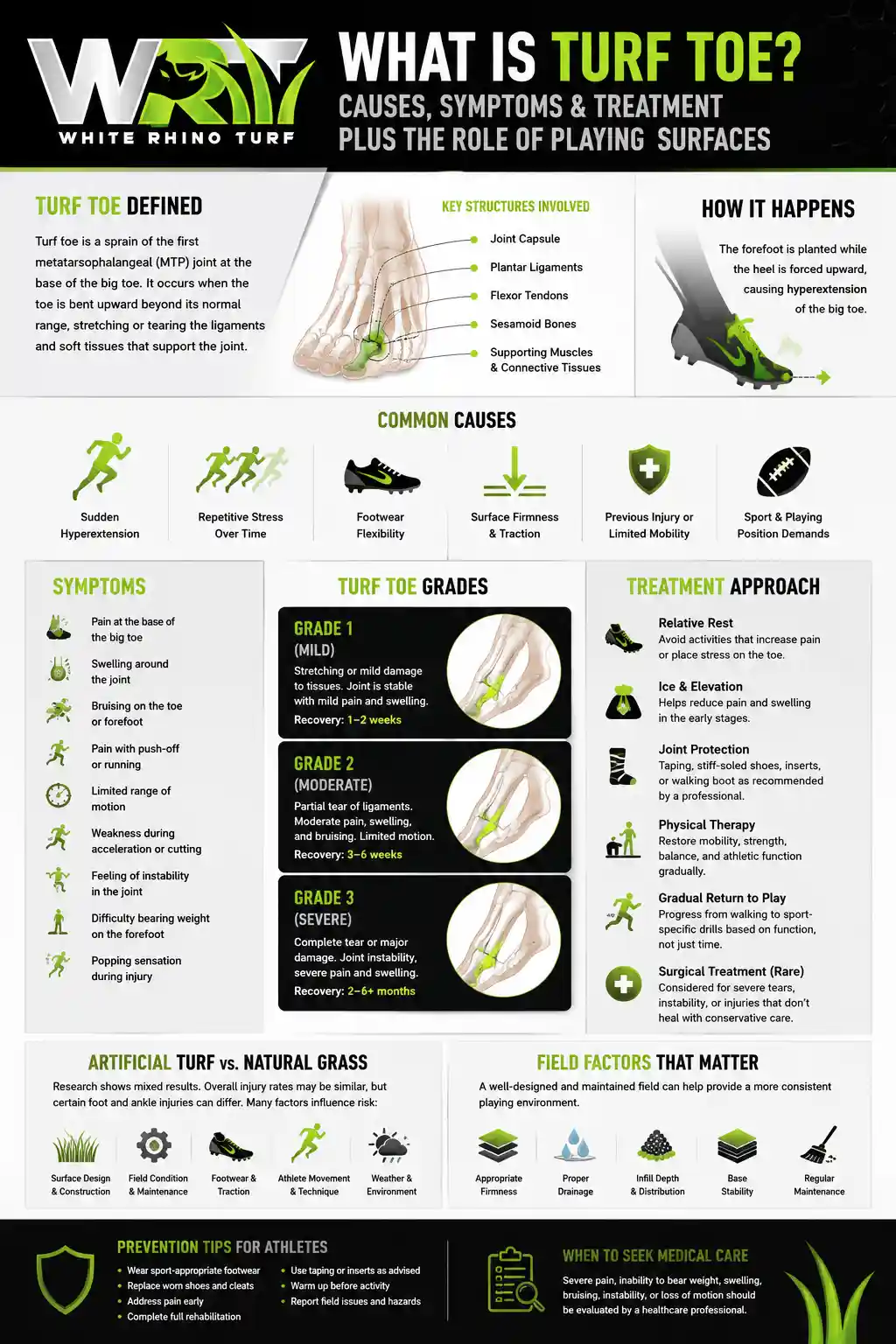
Turf toe is a sprain of the first metatarsophalangeal joint, commonly called the first MTP joint. This is the large joint where the big toe connects to the foot.
The joint plays an important role in walking, running, jumping, and changing direction. As a person moves forward, the heel rises and body weight transfers toward the front of the foot. The big toe bends and helps the athlete push away from the ground.
A turf toe injury occurs when the big toe is bent upward beyond its normal range. This movement, known as hyperextension, can stretch or tear the ligaments, tendons, joint capsule, and other tissues that stabilize the underside of the joint.
A common example occurs when a football player plants the front of the foot while the heel is elevated. Another player may then fall onto the back of the planted leg or drive the athlete forward. The forefoot remains against the ground while the heel continues moving, forcing the big toe upward.
Despite the name, turf toe is not limited to synthetic grass. It can occur on natural grass, hardwood, mats, courts, or other firm surfaces. It can also affect people who are not competitive athletes.
The term became associated with American football as athletes increasingly competed on early artificial turf fields. Those surfaces were generally firmer and less grass-like than many modern systems. Players also began wearing lighter, more flexible shoes that allowed greater movement at the front of the foot.
This combination could place the big toe in a vulnerable position. The shoe gripped the surface, the forefoot remained planted, and the flexible sole offered limited resistance when the toe bent upward.
That history explains the name, but it does not mean every artificial surface causes turf toe. Modern systems may include longer fibers, selected infill, engineered base construction, drainage components, and resilient layers beneath the turf.
Natural grass fields vary considerably as well. One grass field may be soft, even, and carefully maintained, while another may be dry, compacted, muddy, worn, or uneven. The label “natural grass” does not automatically guarantee consistent footing.
A responsible comparison examines the actual construction and condition of each field rather than relying only on the labels “artificial” and “natural.” White Rhino Turf’s guide to artificial turf versus natural grass sports fields explores this broader planning decision.
The first MTP joint is supported by several structures that work together to stabilize the big toe while allowing it to bend.
When the big toe is hyperextended, one or several of these components may be stretched or damaged. A mild injury may involve irritation and microscopic tissue damage. A severe injury can include a complete tear, cartilage damage, fracture, sesamoid displacement, or joint instability.
That is why two athletes diagnosed with turf toe may have very different symptoms and recovery periods.
In football, turf toe commonly happens when a player’s forefoot is planted while the heel is raised. The player may be accelerating from a stance, blocking, cutting, being tackled, or falling forward with the toe trapped against the field.
Different positions may experience the injury in different ways:
The big toe may appear less important than the knee or ankle, but it is central to athletic movement. Pain or instability at the MTP joint can make it difficult to accelerate, jump, cut, or generate force through the front of the foot.
Football facilities considering synthetic playing surfaces should evaluate the complete field assembly rather than the appearance of the turf fibers alone. Product selection, infill, base stability, drainage, use patterns, and surface performance all deserve attention. White Rhino Turf’s information about artificial turf systems for Phoenix football fields provides additional local context.
The immediate cause is excessive upward bending of the big toe, but several circumstances can create that movement.
A single forceful event is the classic cause. The toe stays against the ground while the heel moves upward or forward. Athletes may feel immediate pain and sometimes report a popping sensation.
Turf toe can also develop gradually. Repeated sprinting, jumping, pushing off, or practicing in a position that keeps the toe extended can irritate the joint over time. Mild soreness may become more noticeable as activity continues.
A highly flexible shoe allows the forefoot and toe to bend more freely. Flexibility is not automatically harmful, but it may provide less resistance against excessive extension than a stiffer sole or professionally recommended insert.
Footwear should also match the playing surface. Too little traction may contribute to slipping, while excessive shoe-surface grip may prevent the foot from releasing during a turn.
A firm surface may provide less deformation beneath the foot, while a high-traction surface may hold the planted foot in place during sudden movement. These characteristics can influence forces transferred through the toe and lower body.
However, a surface that is excessively soft, loose, wet, or uneven can create different problems. The goal is not simply to make a field as soft as possible. Sports surfaces should provide stable, predictable, and appropriately resilient footing.
An athlete with a previous toe injury, stiffness, altered foot mechanics, or incomplete rehabilitation may be more vulnerable to recurring problems. Returning to full-speed play before the joint has recovered can place renewed stress on healing tissues.
Sports that require frequent acceleration, cutting, jumping, or forefoot loading create more opportunities for hyperextension. Football is most closely associated with turf toe, but the injury also occurs in soccer, basketball, rugby, lacrosse, wrestling, gymnastics, dance, and running.
Turf toe symptoms can appear immediately after one incident or gradually after repetitive stress. Their intensity depends on the extent of the injury.
A mild sprain may feel like soreness during acceleration. A more serious injury can make normal walking difficult. Severe pain, extensive swelling, visible deformity, numbness, or an inability to bear weight should be assessed promptly.
Healthcare professionals commonly classify turf toe into three grades. The grade helps describe the extent of the damage and guide treatment decisions.
A Grade 1 injury involves stretching or mild damage to the supporting tissues. The joint may be tender and slightly swollen but generally remains stable. An athlete may still be able to walk, although sprinting or forceful push-off can be uncomfortable.
A Grade 2 injury involves a partial tear. Pain, swelling, and bruising are more noticeable. Movement may be limited, and pushing off through the forefoot can be difficult.
The athlete may need more time away from full activity and a structured rehabilitation program. Taping, stiff-soled footwear, an insert, or a walking boot may be considered under professional guidance.
A Grade 3 injury involves a complete tear or major disruption of the supporting tissues. The joint may be unstable, with substantial pain, bruising, swelling, and loss of movement.
Severe cases can involve fractures, cartilage damage, sesamoid displacement, or joint dislocation. Recovery is considerably longer, and surgical evaluation may be necessary.
An athlete cannot reliably determine the grade based on pain alone. Clinical examination and imaging may be needed.
A healthcare professional will usually ask how the injury occurred, where the pain is located, and whether the symptoms appeared suddenly or gradually. The examination may assess swelling, bruising, stability, strength, range of motion, and tenderness around the joint and sesamoid bones.
The injured foot may be compared with the uninjured side. The provider may also evaluate the athlete’s ability to walk, raise the heel, and push through the forefoot.
X-rays may be used to identify fractures, alignment problems, or changes in sesamoid position. Magnetic resonance imaging can provide additional detail about ligaments, tendons, cartilage, and other soft tissues.
An accurate diagnosis is important because turf toe can resemble a fracture, sesamoid injury, arthritis, gout, tendon problem, or another cause of pain around the big toe.
Turf toe treatment depends on the severity of the injury, the athlete’s symptoms, joint stability, and the demands of the sport. Mild injuries may improve with conservative care, while substantial injuries require professional management.
The athlete generally needs to reduce movements that reproduce pain, particularly sprinting, jumping, cutting, and forceful push-off. Continuing full-intensity activity may place additional stress on the injured tissues.
Cold therapy may help manage early pain and swelling after an acute injury. A barrier should be placed between the skin and the cold source. Elevating the foot may also help control swelling.
A healthcare professional may recommend taping, a stiff-soled shoe, an insert, a walking boot, or another method of limiting excessive toe extension. The correct support depends on the injury grade.
Rehabilitation may include exercises intended to restore motion, strength, balance, and tolerance for athletic movement. Progression should be based on function and symptoms rather than a calendar alone.
Athletes may progress from walking to strengthening, jogging, acceleration, cutting, and sport-specific drills. Full participation should not resume until necessary movements can be completed without unacceptable pain, weakness, or instability.
Surgery is uncommon for routine sprains but may be considered for severe tears, unstable joints, fractures, cartilage damage, sesamoid displacement, or injuries that do not respond to appropriate nonsurgical treatment.
Recovery time depends heavily on the injury grade. A mild sprain and a complete tear do not follow the same timeline.
A Grade 1 injury may improve within approximately one or two weeks. A Grade 2 injury may require several weeks, depending on the partial tear and the athlete’s movement demands. A Grade 3 injury can take several months, especially when surgery is required.
Recovery may be influenced by:
An athlete may be able to walk before being ready to sprint, cut, or absorb contact. Return-to-play decisions should therefore be based on athletic function rather than the absence of pain during everyday activities.
Artificial turf does not directly cause every turf toe injury. The immediate injury occurs when the big toe is forcefully hyperextended. However, the surface can affect traction, firmness, foot fixation, and the forces experienced during movement.
Early artificial turf contributed to the injury’s name because it was relatively firm and often paired with flexible shoes. Modern sports-turf systems are different, but no playing surface can eliminate injuries.
Research comparing artificial turf with natural grass has produced mixed and sport-specific findings. Some studies report similar overall injury rates on newer artificial turf and natural grass, while others identify differences in foot, ankle, knee, or other injury categories.
Results can differ according to:
Broad claims that artificial turf is always more dangerous or always safer are not supported by every study. Artificial turf should instead be evaluated as a complete playing system.
Two fields in the same surface category can perform very differently.
Natural grass changes with irrigation, weather, soil compaction, root health, mowing, use, and maintenance. A well-managed professional field may provide a very different playing experience from a drought-stressed community field.
Bare areas, divots, mud, dry soil, uneven grading, and inconsistent coverage can affect footing. In Phoenix, maintaining uniform natural grass also requires considerable irrigation and seasonal management.
Artificial turf varies in fiber structure, pile height, density, infill, backing, drainage, base construction, and the presence or absence of resilient underlayment. An older, compacted surface should not be assumed to perform like a properly maintained modern field.
White Rhino Turf provides a broader breakdown of the characteristics considered when selecting turf for sports fields, including the importance of matching the system to the intended activity and usage level.
One surface may have a similar overall injury rate while producing a different distribution of foot, ankle, knee, muscle, or abrasion injuries. Facility decision-makers should therefore examine the sport, study population, field condition, and injury category before applying a statistic to a local project.
No field feature can guarantee injury prevention, but several characteristics affect how athletes experience the surface.
A field that is too firm may transmit greater forces to the body. A surface that is too soft may feel unstable or reduce predictable footing. Appropriate firmness depends on the sport and complete system.
Athletes need enough traction to accelerate and change direction. Excessive grip may keep the foot fixed while the body rotates, while insufficient grip can contribute to slipping. Footwear and playing surface must be considered together.
Infill supports the fibers and contributes to the playing characteristics of many synthetic systems. Its depth and distribution can change as a field is used, particularly in high-traffic zones.
The base beneath the field supports grading, drainage, and surface consistency. Localized settling, poor compaction, or an unsuitable foundation can create uneven areas and unpredictable footing.
Some assemblies include a pad or resilient component beneath the turf. These layers may influence impact attenuation, but their suitability must be evaluated as part of the complete system rather than through marketing terminology alone.
Water should move through or away from the field as intended. Poor drainage can create ponding, soft areas, infill movement, or inconsistent conditions after rain.
Brushing, debris removal, infill management, seam observation, repair of damaged areas, and appropriate testing can help identify changes in a field’s condition.
Commercial sports turf installation in Phoenix requires planning for a climate that can place considerable stress on natural and synthetic playing surfaces.
Artificial turf can become significantly hotter than the surrounding air under direct sun. Natural grass is often cooler because of moisture and evapotranspiration, although maintaining that effect requires irrigation and healthy plant growth.
Heat is primarily an athlete-comfort and heat-exposure concern rather than a direct explanation for every turf toe injury. Facility operators should establish appropriate hydration, scheduling, rest, and heat-management procedures.
Phoenix receives prolonged, intense sunlight. Sports-turf materials should be selected with local UV exposure in mind. UV stability is important for long-term fiber integrity, but no outdoor material is completely unaffected by age and exposure.
Hard native soil does not automatically provide a suitable finished foundation. Field performance depends on base construction, grading, compaction, and drainage rather than native ground alone.
Arizona is dry for much of the year, but monsoon storms can produce intense rainfall within a short period. A field should be designed to manage those events without prolonged ponding or uncontrolled erosion.
School fields, training areas, HOA recreation spaces, and commercial facilities may host practices, games, camps, physical-education classes, and community events. Artificial turf can provide consistent coverage under frequent use, but expected traffic should influence product and system selection.
Natural sports grass requires irrigation, particularly during Phoenix’s hottest months. Artificial turf reduces the routine irrigation needed to keep grass alive, although water may still be used for certain cleaning, cooling, or management procedures.
Organizations planning multipurpose recreation areas can also review White Rhino Turf’s information on synthetic playground and active-recreation surfaces.
A shock-absorbing layer may influence impact attenuation and overall field performance, but it should not be presented as a guaranteed way to prevent turf toe.
Turf toe is primarily a hyperextension injury. Its occurrence may involve forefoot position, shoe flexibility, traction, player contact, anatomy, movement, and previous injury. A resilient component addresses only one part of the athlete-surface interaction.
Facility planners should be cautious with phrases such as “injury-proof turf” or “turf that prevents injuries.” No field can eliminate the physical risks of football, soccer, lacrosse, or other athletic activities.
A more responsible process is to define measurable requirements for the complete field. Depending on the project, this may include impact attenuation, surface consistency, rotational resistance, drainage, infill condition, accessibility, and expected traffic.
The appropriate assembly depends on the sport, player age, use schedule, field dimensions, applicable standards, and long-term management plan. “Padded synthetic grass” is not a complete field specification.
There is no single turf product that is automatically best for every facility. A system designed for an indoor training lane may not be appropriate for a full football field. A playground has different use patterns and performance considerations than a soccer complex.
Planning should begin with several questions:
The best system is one selected for the actual activity, supported by proper construction, and managed throughout its usable life. Appearance alone does not answer these questions.
No prevention strategy removes all risk, but several practices may help reduce avoidable stress on the big toe.
Sports-field safety is not achieved through one product claim. It requires planning, inspection, documentation, and timely responses to changing conditions.
A practical field-management program may include:
Surface age also matters. Fibers can wear, infill can migrate or compact, seams can be stressed, and the base can develop localized issues. A field should be evaluated according to its actual condition rather than its age alone.
Facilities experiencing widespread wear, failing seams, drainage issues, instability, or repeated repairs may benefit from reviewing the difference between localized work and complete turf replacement in Phoenix.
An athlete should consider medical evaluation when pain is substantial, symptoms are not improving, or the injury affects normal walking and push-off.
Prompt assessment is especially important when there is:
A healthcare professional can distinguish a sprain from a fracture, dislocation, sesamoid injury, or another condition requiring different treatment.
Turf toe is a sprain of the main joint at the base of the big toe. It occurs when the toe is bent upward beyond its normal range while the forefoot is planted. The injury is common in activities involving sprinting, jumping, cutting, and contact.
Common symptoms include pain and tenderness at the base of the big toe, swelling, bruising, reduced motion, weakness during push-off, and difficulty running or changing direction. Severe injuries may make walking difficult or cause the joint to feel unstable.
A mild injury may improve within one or two weeks. A partial tear may require several weeks, while a severe injury can take several months. Recovery varies according to the extent of the damage and the demands of the athlete’s sport.
Artificial turf does not independently cause every sports injury. Research findings vary by sport, athlete population, field condition, footwear, surface type, and injury category. The complete playing environment should be evaluated rather than the turf material alone.
Yes. Turf toe can occur on natural grass, artificial turf, courts, mats, gym floors, and other surfaces. The defining mechanism is forceful hyperextension of the big toe.
No field system can eliminate turf toe or other sports injuries. Resilient components may contribute to field performance, but turf toe also involves traction, footwear, athlete movement, contact, anatomy, and previous injury.
Turf toe is a sprain of the big toe joint caused by excessive upward bending. The injury became closely associated with artificial turf because it gained attention among football players using early synthetic surfaces, but it can happen on almost any field or court.
The relationship between playing surfaces and sports injuries is more nuanced than the injury’s name suggests. Artificial turf and natural grass each vary in quality, firmness, traction, condition, and maintenance. Research may find comparable overall injury rates while identifying differences within particular sports or injury categories.
For Phoenix schools, athletic organizations, HOAs, and commercial facilities, the most useful approach is to focus on the complete playing environment. That includes selecting a system for the intended activity, preparing a stable base, planning drainage for monsoon storms, accounting for high UV exposure, managing surface temperatures, matching footwear to field conditions, and inspecting the area throughout its usable life.
A well-planned field cannot guarantee that athletes will avoid injury. It can provide a more consistent and purpose-appropriate setting than a surface chosen without considering sport, traffic, climate, drainage, and long-term management.
White Rhino Turf’s overview of artificial turf and real grass in Arizona offers additional information about how local environmental conditions affect the broader surface decision.

White Rhino Turf delivers professional artificial turf installation in East Valley AZ and across Phoenix. From pet turf and putting greens to full backyard transformations, our licensed in-house crews complete most projects in two weeks or less—with warranties and financing that give homeowners peace of mind.