- Home
- Locations
- Turf Installation
- Services
- About
- Recent Projects
- Blog
- Contact
Artificial turf is designed to provide years of consistent appearance and performance, but the materials within a turf system do not necessarily remain unchanged for the entire life of the lawn. One component homeowners often overlook is artificial turf infill.
So, does artificial turf need infill replacement over time?
Not necessarily on a fixed schedule. Artificial turf infill can settle, migrate, compact, or become uneven as a lawn ages. In some situations, redistributing or replenishing infill may help restore blade support and improve the appearance of otherwise healthy turf. Complete infill replacement, however, is not something every artificial lawn automatically requires after a certain number of years.
The more important question is why the infill level or turf performance has changed.
Low infill can sometimes be a relatively minor maintenance issue. In other cases, flattened fibers, persistent odors, drainage problems, separated seams, sinking areas, or deteriorating backing indicate that the problem extends beyond the infill.
Phoenix conditions add another layer to the equation. Artificial turf in Arizona is exposed to intense sunlight, desert dust, year-round backyard activity, pets, landscape debris, and powerful monsoon storms. Understanding how infill fits into the entire turf system can help homeowners recognize normal maintenance needs while also spotting signs that an aging artificial lawn may need a more comprehensive evaluation.
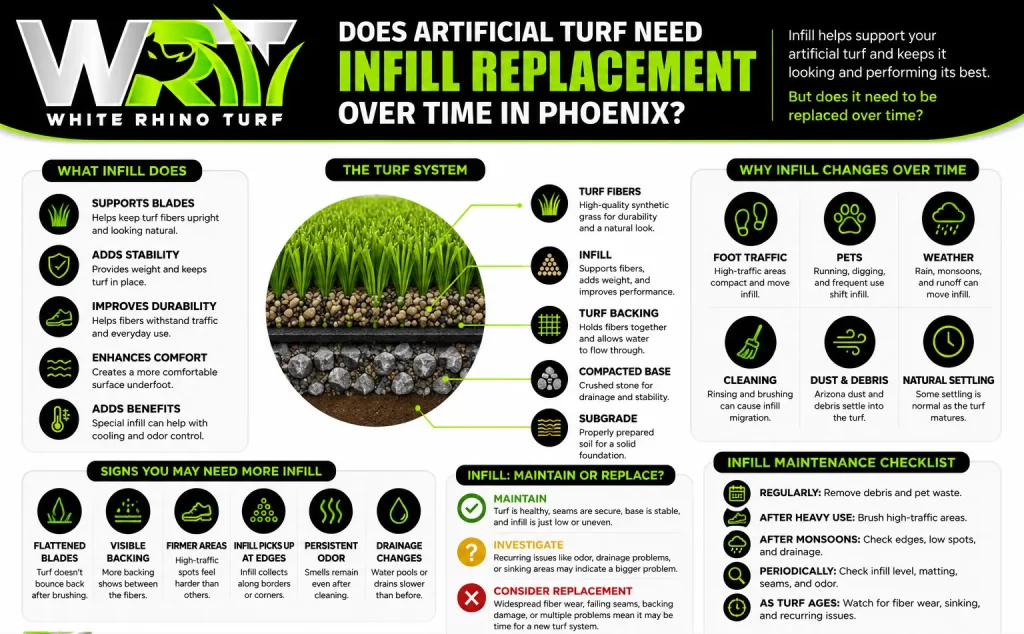
Artificial turf infill is the granular material distributed between synthetic grass blades during installation. Depending on the turf product and application, the infill may sit largely out of sight near the lower portion of the fibers.
Although artificial grass blades receive most of the attention, infill can perform several important functions.
Properly selected and installed infill can help:
Infill is only one part of an artificial lawn.
Professional artificial turf installation in Phoenix also depends on excavation, subgrade preparation, base construction, compaction, grading, drainage, turf backing, seams, edge security, and final grooming.
Thinking of turf as a complete system becomes particularly important as the installation gets older. A surface problem that appears to involve infill may actually originate somewhere else within that system.
Not every artificial turf installation uses the same infill. The appropriate material depends on the turf product, application, manufacturer specifications, desired performance, and how the outdoor space will be used.
Common categories can include:
Silica sand is commonly used in artificial turf systems to provide ballast and support turf fibers. The appropriate quantity and particle specifications depend on the turf system.
Some installations, particularly yards used by dogs, may incorporate infill products intended to help manage odors.
These products should not be viewed as a substitute for cleaning or proper drainage. Pet urine still needs to move effectively through the turf system, and pet waste should be removed and affected areas cleaned.
Specialty infill products may be incorporated into turf systems with surface-temperature management in mind.
Cooling infill does not make artificial turf immune to Arizona heat, and infill is only one factor affecting surface temperature. Turf construction, blade characteristics, density, direct sunlight, shade, surrounding hardscapes, and other conditions can influence how hot the surface becomes.
Homeowners concerned about summer temperatures can learn more about cooling artificial turf for Arizona conditions.
Pet turf systems may use materials selected with odor management, drainage, durability, or surface performance in mind.
The important takeaway is that infill is not interchangeable. Homeowners should not assume that any bag of sand or landscape material can simply be spread across an existing artificial lawn.
The type of turf, existing infill, pile height, application, and manufacturer recommendations should all be considered.
Artificial turf infill does not have a universal replacement schedule.
A homeowner may encounter recommendations suggesting infill should be replaced every specific number of years, but actual conditions vary considerably from one installation to another.
In many cases, the issue is not that all of the existing material has suddenly become unusable. Instead, infill may have:
A relatively young artificial lawn with healthy fibers, secure seams, a stable base, and good drainage may only need normal grooming or infill redistribution.
An older lawn with brittle fibers, widespread matting, recurring odor, drainage problems, separating seams, or sinking areas presents a different situation.
Adding new infill cannot restore a turf system that is failing elsewhere.
This is why the condition of the entire artificial lawn matters more than the age of the infill alone.
Some settling after artificial turf installation can be normal.
Infill works its way between the turf fibers, and use of the lawn can change how that material is distributed. The surface may also look somewhat different after it has been walked on, groomed, and used regularly.
Normal settling should be distinguished from ongoing infill loss or another turf problem.
Potential warning signs include:
A new lawn should not require homeowners to continually add material without understanding why the infill is disappearing or moving.
Artificial turf is exposed to constant activity. People walk across it, children play on it, dogs run through it, furniture is moved, landscaping is maintained, and the surface is cleaned.
Over time, these activities can affect infill distribution.
Frequently traveled sections of a lawn can behave differently from decorative areas that receive little activity.
High-use locations commonly include:
Repeated traffic can contribute to compaction and movement while also causing the turf fibers themselves to gradually lay over.
Dogs frequently establish predictable routes through a yard.
Running along a fence, turning near a gate, playing in the same area, or repeatedly using one bathroom location can create concentrated wear.
Those areas may look and feel different from the rest of the lawn long before the entire installation develops the same symptoms.
Artificial grass benefits from appropriate maintenance, but aggressive brushing, cleaning, or other surface activity can redistribute material.
Grooming should be performed using methods suitable for the specific turf system.
Phoenix receives relatively little annual rainfall, but Arizona monsoons can deliver significant amounts of water over short periods.
Proper grading and drainage should manage rainfall, but surrounding landscape runoff and debris can still affect a turf area.
Repeated infill movement around a low spot or edge may warrant investigating the surrounding drainage rather than continually replacing the material.
There is no single infill depth or quantity that is correct for every artificial turf product.
The appropriate amount can depend on:
That is why homeowners should be cautious about using a universal pounds-per-square-foot recommendation found online.
Two artificial lawns can look similar while being engineered around different turf and infill specifications.
It is also difficult to judge infill quantity simply by looking down at the surface. Infill generally sits lower between the turf blades, so the fact that large amounts of material are not immediately visible does not automatically mean the lawn needs more.
The better approach is to consider the specifications of the turf system and evaluate whether there are actual symptoms of inadequate or uneven infill.
Insufficient infill can affect the way an artificial lawn looks and performs.
Depending on the turf system, low infill may contribute to:
Infill helps support synthetic fibers. Areas with inadequate material may have less support around the lower portion of the blades.
High-traffic areas can begin to look flatter, particularly when low infill occurs alongside repeated use.
Separating the fibers may reveal more of the backing in areas where infill has become significantly lower.
An area may feel different underfoot compared with sections where the turf system remains properly supported.
A lawn with dramatically different infill levels may develop visual differences between sections.
These symptoms do not prove that low infill is the only problem.
Severely worn fibers, poor installation, base movement, or aging turf can create similar symptoms. That is why diagnosing the underlying cause matters before additional material is added.
Yes. More infill is not automatically better.
Artificial turf systems are designed around appropriate quantities of specific materials. Adding excessive infill can alter how the turf looks and feels and may cover more of the blades than intended.
Too much infill may also make it harder to determine what was actually causing the original problem.
For example, if an older lawn is severely matted because the turf fibers are worn, burying the lower portion of those fibers under additional material does not restore their original condition.
The goal should be the correct amount of compatible infill, not simply as much material as possible.
Homeowners considering adding infill should first determine:
No single symptom proves artificial turf needs more infill. However, several changes can indicate that the infill level and overall turf condition should be inspected.
Some fiber layover is normal as turf ages, particularly in frequently used areas.
If one part of the lawn stays substantially flatter than another, low or compacted infill could be contributing.
Grooming may help slightly matted turf. Fibers that remain permanently flattened can also indicate wear.
If separating the blades exposes significantly more backing than expected, the infill level may be low.
However, severely worn or matted fibers can produce a similar appearance.
Walkways, play areas, gates, and other frequently used locations may become firmer or flatter as the system ages.
Comparing these areas with lightly used sections can make changes easier to recognize.
Material accumulating around curbing, walls, borders, or other edges can indicate migration.
A small amount may simply need redistribution. Repeated movement deserves closer attention.
Artificial turf rarely experiences perfectly uniform traffic.
Areas beneath furniture, along pet routes, near doors, and around gathering spaces can age differently.
Odor should not automatically be blamed on infill.
Pet urine and organic material can affect different parts of a turf system. Homeowners should begin with appropriate cleaning before assuming material needs replacement.
White Rhino’s guide on how to remove pet odor from artificial turf explains common causes and cleaning considerations in more detail.
Standing water or unexpectedly slow drainage should prompt a broader evaluation.
Drainage depends heavily on turf backing, base preparation, grading, compaction, and surrounding landscape conditions. An infill change alone may not explain the problem.
Additional compatible infill can sometimes be added to an existing artificial lawn, particularly where otherwise healthy turf has experienced minor settling or material migration.
But simply pouring new material over old infill is not always appropriate.
Before adding anything, determine:
Redistribution may sometimes be more appropriate than adding material.
Likewise, adding clean infill over contaminated material does not address the source of a persistent odor problem.
Homeowners can perform several basic turf inspections and maintenance tasks themselves.
For example, you can:
Adding infill becomes more complicated when the original turf or infill specifications are unknown.
Using an incompatible product or applying the wrong quantity may create a new issue without correcting the original one.
Problems involving widespread odor, drainage failure, base movement, deteriorating fibers, backing damage, or multiple failing seams should be viewed as larger turf-system concerns rather than simple DIY infill maintenance.
Pet turf can experience concentrated use patterns that differ from lightly used decorative artificial grass.
Dogs often use the same:
Those locations can develop more matting or infill movement than surrounding sections.
Urine also adds another maintenance consideration.
Pet-oriented infill can be part of an odor-management strategy, but infill is not a replacement for cleaning and drainage. Urine needs to move through the turf system effectively, solid waste should be removed promptly, and affected areas should be cleaned appropriately.
A persistent smell can potentially involve the turf surface, infill, trapped organic debris, drainage conditions, or contamination deeper within the base.
Applying fresh infill over an unresolved contamination problem may only mask the symptom.
For ongoing care, White Rhino’s guide to cleaning and deodorizing artificial turf in Arizona covers routine maintenance in greater detail.
Artificial turf in Phoenix experiences conditions that are considerably different from lawns installed in many cooler climates.
Artificial turf can become hot in direct Arizona sunlight.
Infill can influence surface performance, particularly when specialty cooling materials are used, but it is not the only factor affecting temperature.
Turf fiber construction, blade shape, density, direct sunlight, shade, surrounding hardscapes, and the overall installation can all matter.
Cooling infill should therefore be treated as one component of a heat-conscious turf system rather than something that automatically needs to be added to every existing lawn.
Fine dust is a constant part of maintaining outdoor surfaces in the Valley.
Dust can settle between turf fibers along with leaves, pollen, and other debris. Regular debris removal and appropriate rinsing or grooming can help keep the surface cleaner.
Artificial turf frequently borders decomposed granite, decorative rock, desert landscaping, and hardscape areas in Phoenix yards.
Small pieces of surrounding landscape material can be kicked or washed onto turf.
Removing this material periodically helps prevent foreign debris from becoming mixed throughout the turf.
After a significant monsoon storm, homeowners should inspect:
Repeated erosion, sinking, or pooling is more likely to indicate a base, grading, or drainage concern than a simple need for additional infill.
Infill can influence conditions at the turf surface, but major artificial turf drainage performance depends on much more than infill.
A properly functioning system relies on:
Adding infill should not be treated as a solution for water pooling over an unstable or improperly graded base.
Likewise, removing infill is unlikely to correct a drainage system that was poorly constructed from the beginning.
If a lawn previously drained well and now develops persistent pooling, the change should be investigated rather than automatically attributed to the infill.
Sometimes, but not always.
If otherwise healthy turf is flattening because material has migrated away from a heavily used area, appropriate grooming and infill redistribution may improve blade support.
The situation changes when the fibers themselves have deteriorated.
Artificial turf can eventually experience permanent wear. Older fibers may become increasingly flat, brittle, or unable to recover their original appearance.
In that situation, additional infill may make the lawn look slightly different without addressing the actual problem.
This distinction is particularly important on older installations. A homeowner can continue treating individual surface symptoms even though the turf itself has reached the point where replacement is becoming the more practical long-term option.
There is no universal maintenance calendar for every artificial turf system, but homeowners can use a simple condition-based inspection routine.
| When to Check | What to Look For |
|---|---|
| During routine yard maintenance | Leaves, debris, pet waste, visible infill movement, and unusual matting |
| After periods of heavy use | Flattened fibers, compacted high-traffic areas, and uneven appearance |
| After major monsoon storms | Debris, edge movement, low spots, drainage problems, and displaced material |
| When cleaning pet areas | Persistent odor, concentrated wear, and changes in drainage |
| As the turf gets older | Fiber wear, backing condition, seams, edges, base stability, and recurring problems |
The goal is not to constantly disturb the turf.
Regular observation simply makes it easier to identify small changes before they become confused with larger installation problems.
The most useful question is often not:
“Does my artificial turf need more infill?”
Instead, ask:
“Why is my artificial turf performing differently?”
| What You’re Seeing | Maintenance or Infill May Help | Full Turf Evaluation May Be Needed |
|---|---|---|
| Minor flattening | Yes | If it persists |
| Slightly low infill | Yes | Usually not by itself |
| Uneven infill distribution | Yes | If it repeatedly returns |
| Compacted high-traffic area | Possibly | If fibers are badly worn |
| Persistent odor | Cleaning may help | Yes, if contamination is deeper |
| Widespread brittle fibers | No | Yes |
| Multiple failing seams | No | Yes |
| Sinking or uneven base | No | Yes |
| Recurring drainage problems | Not usually | Yes |
| Damaged backing | No | Yes |
New infill cannot:
White Rhino Turf’s artificial turf replacement services in Phoenix are intended for situations where an existing turf system has deteriorated beyond what routine maintenance can reasonably address.
White Rhino Turf does not provide standalone infill replacement or turf repair services.
Homeowners can think about an aging artificial lawn in three categories.
Routine maintenance may be appropriate when:
In these situations, cleaning, grooming, or proper infill redistribution may be all the lawn needs.
Take a closer look when:
These symptoms do not automatically mean replacement is necessary, but they suggest the problem may involve more than routine surface maintenance.
A comprehensive evaluation becomes more appropriate when:
One low-infill area rarely means an entire lawn needs replacement.
Multiple system failures tell a very different story.
There is no universal replacement interval for artificial turf infill. Condition depends on the turf system, infill material, traffic, pets, maintenance, drainage, and installation. Some lawns may need material redistributed or replenished rather than completely replaced.
Yes. Infill can settle, migrate, compact, or become unevenly distributed as artificial turf is used. High-traffic areas can behave differently from sections that receive little activity.
Potential signs include flattening, visible backing, uneven infill distribution, changes in surface feel, or material accumulating near edges. Similar symptoms can also result from turf wear or installation problems, so the entire system should be considered.
Depending on the turf system, insufficient infill can reduce blade support, contribute to matting, expose more of the backing, and create an uneven appearance or feel. Low infill is not the only possible cause of these symptoms.
Yes. Turf products are designed around appropriate infill quantities. Excessive material can change the appearance and feel of the surface and cover more of the fibers than intended.
Homeowners can inspect and groom their turf, but adding infill requires knowing the turf specifications, existing material, appropriate infill type, and correct quantity. Unknown products, contamination, drainage issues, or older turf can make the situation more complicated.
Not necessarily. Pet odor may involve the turf surface, infill, organic debris, drainage, or contamination deeper in the base. Adding fresh infill without resolving the source of the odor may only provide a temporary improvement.
Infill is one component of the turf system, but drainage depends heavily on turf backing, base construction, grading, compaction, and installation. Adding new infill will not repair a failing drainage system.
Some installations use specialty cooling infill, but infill is only one factor affecting surface temperature. Turf construction, direct sunlight, shade, surrounding materials, and overall system design also matter.
Minor infill loss or uneven distribution does not automatically justify replacing an artificial lawn. Replacement becomes more appropriate to evaluate when infill concerns occur alongside widespread fiber deterioration, backing failure, separated seams, base movement, persistent odor, or serious drainage problems.
Artificial turf infill can change as a lawn ages, but there is no fixed point when every Phoenix artificial lawn suddenly needs complete infill replacement.
Some turf systems may eventually benefit from infill redistribution or replenishment. Other lawns primarily need cleaning or grooming. Older installations may develop problems that have little to do with the infill at all.
The best approach is to look at the entire artificial turf system.
Pay attention to how the fibers are aging. Monitor high-traffic areas. Keep debris under control. Watch seams and edges. Notice drainage changes. Check for sinking, persistent odors, or deterioration that repeatedly returns after maintenance.
Most importantly, distinguish a minor surface-maintenance issue from a turf system that is beginning to fail.
Infill can support a healthy artificial lawn, but adding more material cannot indefinitely compensate for deteriorating fibers, damaged backing, poor drainage, unstable base material, or widespread installation failure.
White Rhino Turf installs artificial grass systems throughout the Phoenix area and provides complete turf replacement services when an existing installation has reached the point where replacement makes more sense than continued maintenance.
Understanding what infill does—and what it cannot do—helps Phoenix homeowners make a more informed decision about what their artificial lawn actually needs.

White Rhino Turf delivers professional artificial turf installation in East Valley AZ and across Phoenix. From pet turf and putting greens to full backyard transformations, our licensed in-house crews complete most projects in two weeks or less—with warranties and financing that give homeowners peace of mind.