
- Home
- Locations
- Turf Installation
- Services
- About
- Recent Projects
- Blog
- Contact
Phoenix homeowners turn to artificial turf to save water, minimize maintenance, and enjoy a consistently green landscape despite the desert environment. Yet the North American Monsoon season, running roughly from mid-June through September, presents specific challenges. These convective thunderstorms can deliver 1–3 inches (or more) of rain in short bursts, sometimes within an hour. When paired with the Valley’s heavy clay soils, which absorb water slowly and hold moisture, poor drainage can result in standing water, prolonged wet spots, increased pet odors, mosquito breeding, and even minor structural concerns.
A well-designed artificial turf system actually drains far more efficiently than natural grass, often at rates of 30 to several hundred inches of water per hour. In this educational guide, we explain how drainage systems function in Arizona conditions, highlight the most common installation mistakes, share proven monsoon-proof techniques, and explore effective turf cooling methods that work alongside good drainage to keep your backyard comfortable during extreme summer heat.
Phoenix typically receives only about 8 inches of annual rainfall, with the monsoon contributing roughly 2.4–2.8 inches on average. However, the intensity of individual storms — combined with clay-rich soils that expand when wet and slow percolation — increases risks of pooling and runoff.
Without proper drainage:
Effective drainage not only prevents these issues but also supports faster surface drying, which indirectly aids in keeping the turf cooler. For more on heat management, see our guide on how to keep artificial turf cool in Arizona heat.
Artificial turf drainage is a multi-layer permeable system that allows water to move vertically through the turf and then horizontally away from the installation area via proper grading.
Here’s the educational breakdown of a high-performance stack used in Phoenix-area installations:
When engineered correctly, this system handles intense monsoon bursts efficiently while maintaining a stable, usable surface.
Many drainage problems stem from shortcuts that compromise the system’s long-term function. Here are the most frequent issues observed in the Valley:
To create a reliable system tailored to Phoenix:
Professional in-house crews experienced in local conditions can typically complete most residential projects efficiently — often within about two weeks — while maintaining high standards.
For ongoing care that preserves drainage, refer to our artificial turf maintenance guide for Arizona, which includes post-storm brushing and rinsing recommendations.
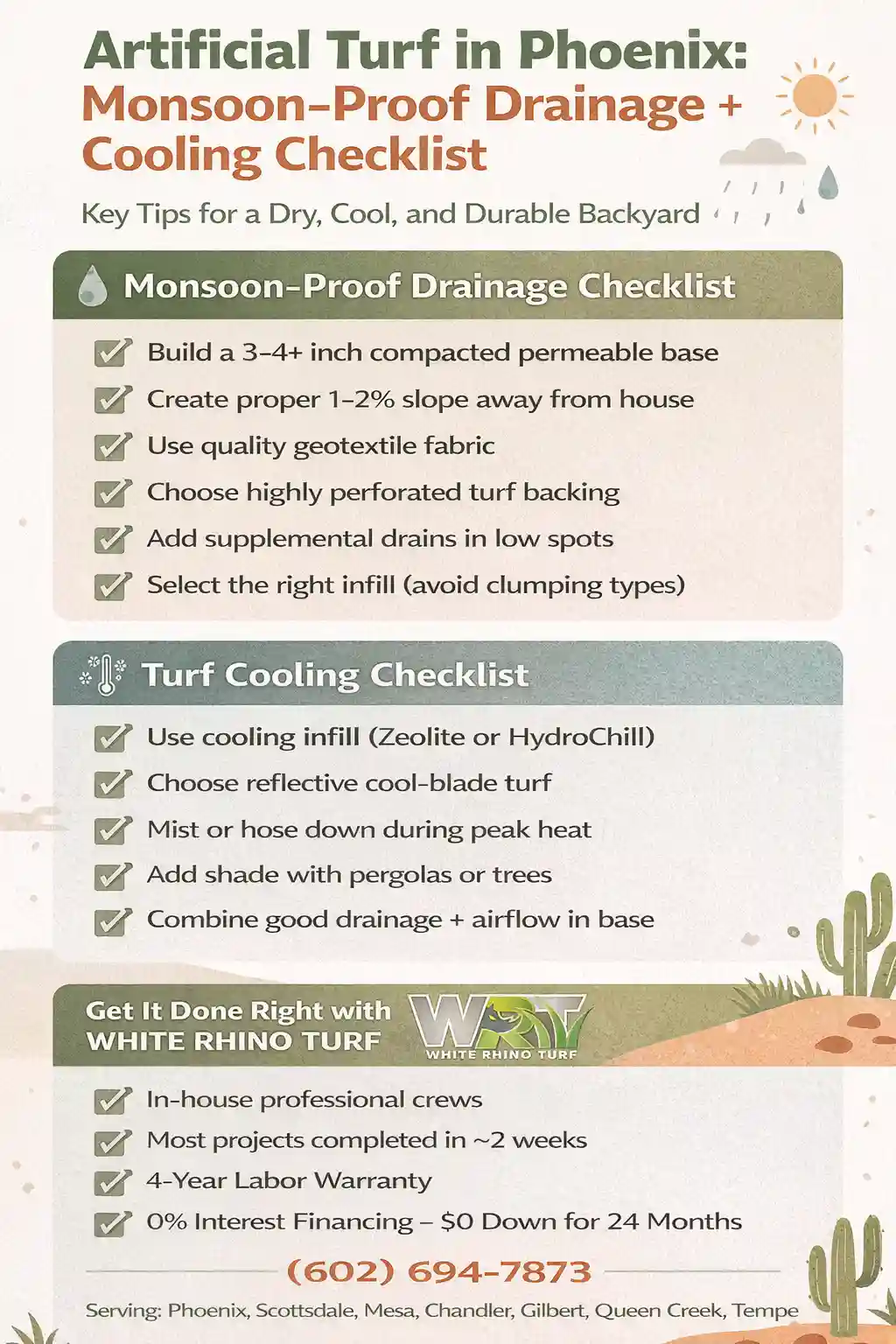
Good drainage pairs naturally with effective cooling strategies, as faster-drying surfaces stay more comfortable. Artificial turf can get significantly warmer than natural grass in full sun, but several proven techniques help manage surface temperatures in Phoenix’s extreme heat (often exceeding 110°F in summer).
Specialized infills are one of the most effective long-term solutions. Products like HydroChill infill or zeolite-based options absorb moisture and release it slowly through evaporative cooling. When activated, these can lower surface temperatures by 30–50°F for several hours.
Modern turf products incorporate pigments, UV inhibitors, and specially shaped blades that reflect infrared radiation. Lighter blade colors further reduce heat buildup. These “cool-touch” yarns can keep the surface noticeably more comfortable compared to standard darker turfs.
A quick hose-down or misting during peak afternoon heat (1–4 p.m.) provides immediate evaporative cooling. Because well-drained turf dries quickly, this method is efficient and doesn’t lead to prolonged saturation.
Partial shade from pergolas, shade sails, or drought-tolerant trees can reduce direct sun exposure and lower surface temperatures by 15–25°F or more in shaded spots.
A permeable, well-compacted base with good airflow underneath helps dissipate trapped heat. This is another reason thorough drainage engineering benefits overall comfort.
These cooling techniques work best when integrated during the initial installation. At White Rhino Turf, we evaluate your site’s sun exposure and recommend the best combination of fibers, infill, and design features for Phoenix conditions.
If you notice puddling, slow drying, or uncomfortably hot surfaces:
We believe in educating homeowners so you can make confident decisions. Our in-house crews handle every project with attention to local Phoenix Valley conditions across Phoenix, Scottsdale, Mesa, Chandler, Gilbert, Queen Creek, and Tempe. We perform detailed site assessments, use premium materials, and engineer both drainage and cooling features tailored to your yard.
We stand behind our workmanship with a 4-year labor warranty and complete most projects efficiently — typically within about two weeks. To make your project more accessible, we also offer 0% interest financing with $0 down for 24 months.
Learn more about our full process on our artificial turf installation in Phoenix page.
When properly installed with adequate base and slope, it drains rapidly — often staying usable shortly after storms end.
Yes — combining cooling infill, reflective fibers, and occasional watering can reduce surface temperatures significantly, often by 30–50°F when activated.
A minimum of 3–4 inches (deeper in low areas) of compacted permeable aggregate is standard.
Targeted, short sprays on well-drained turf use far less water than maintaining natural grass and provide temporary relief when needed most.
We offer 0% interest financing with $0 down for 24 months to help make quality installations more affordable.
Proper drainage and thoughtful cooling techniques together create an outdoor space that performs reliably through Arizona’s intense summers and monsoons.
If you’re planning a new installation or want to evaluate your current turf, contact White Rhino Turf for a free on-site assessment. We’ll review your yard’s specific drainage and heat challenges, recommend the best solutions, and provide clear details — including our 4-year labor warranty and 0% interest financing options.
Call us at (602) 694-7873 or fill out our quick contact form to schedule your consultation in Phoenix, Scottsdale, Mesa, Chandler, Gilbert, Queen Creek, or Tempe.
Have questions about drainage layers, cooling infill options, or how these features work together in your yard? Leave a comment below — we’re happy to help educate Valley homeowners on building better backyards.

White Rhino Turf delivers professional artificial turf installation in East Valley AZ and across Phoenix. From pet turf and putting greens to full backyard transformations, our licensed in-house crews complete most projects in two weeks or less—with warranties and financing that give homeowners peace of mind.