
- Home
- Locations
- Turf Installation
- Services
- About
- Recent Projects
- Blog
- Contact
Phoenix summers create some of the most demanding conditions artificial turf can face. Extended periods of triple-digit heat, intense UV exposure, minimal cloud cover, and direct afternoon sun can cause outdoor surface temperatures to rise far above the surrounding air temperature.
That leads to one of the most common questions Arizona homeowners, pet owners, HOAs, and property managers ask: how hot does artificial turf get in Arizona?
Artificial turf can exceed 150°F in direct summer sun under extreme conditions. Actual turf temperature depends on air temperature, sun exposure, fiber construction, infill, shade, moisture, and surrounding materials. Synthetic turf generally becomes hotter than natural grass because it does not cool itself through evaporation and transpiration.
That does not mean every artificial lawn in Phoenix will reach the same temperature. A shaded turf area can perform very differently from turf exposed to several hours of direct afternoon sun, and modern turf systems can incorporate heat-resistant fibers, cooling infill, shade planning, and other strategies to reduce surface heat.
This guide explains artificial turf temperature in Arizona, why turf gets hot in the sun, how it compares with concrete and natural grass, what Phoenix homeowners should know about pets and barefoot use, and which design choices can help keep turf cooler.
Arizona Turf Temperature: Key Takeaways
Artificial turf surface temperature can rise well above the surrounding air temperature because synthetic fibers absorb solar radiation throughout the day. Research summarized by Penn State’s Center for Sports Surface Research has documented synthetic turf surface temperatures substantially above ambient air temperatures. In one set of field measurements, several synthetic turf products reached approximately 139°F to 161°F while measured air temperatures were about 83°F to 87°F. Penn State’s synthetic turf temperature research provides additional measurements and comparisons.
The important distinction is between air temperature and surface temperature. A Phoenix weather forecast of 105°F does not mean your driveway, pavers, pool deck, artificial grass, or other exposed surfaces will also be 105°F. Materials exposed to direct solar radiation may become considerably hotter than the ambient air.
Artificial turf temperature also varies from one installation to another. Important factors include:
For that reason, a single temperature number should not be treated as the expected temperature of every artificial lawn in Arizona.
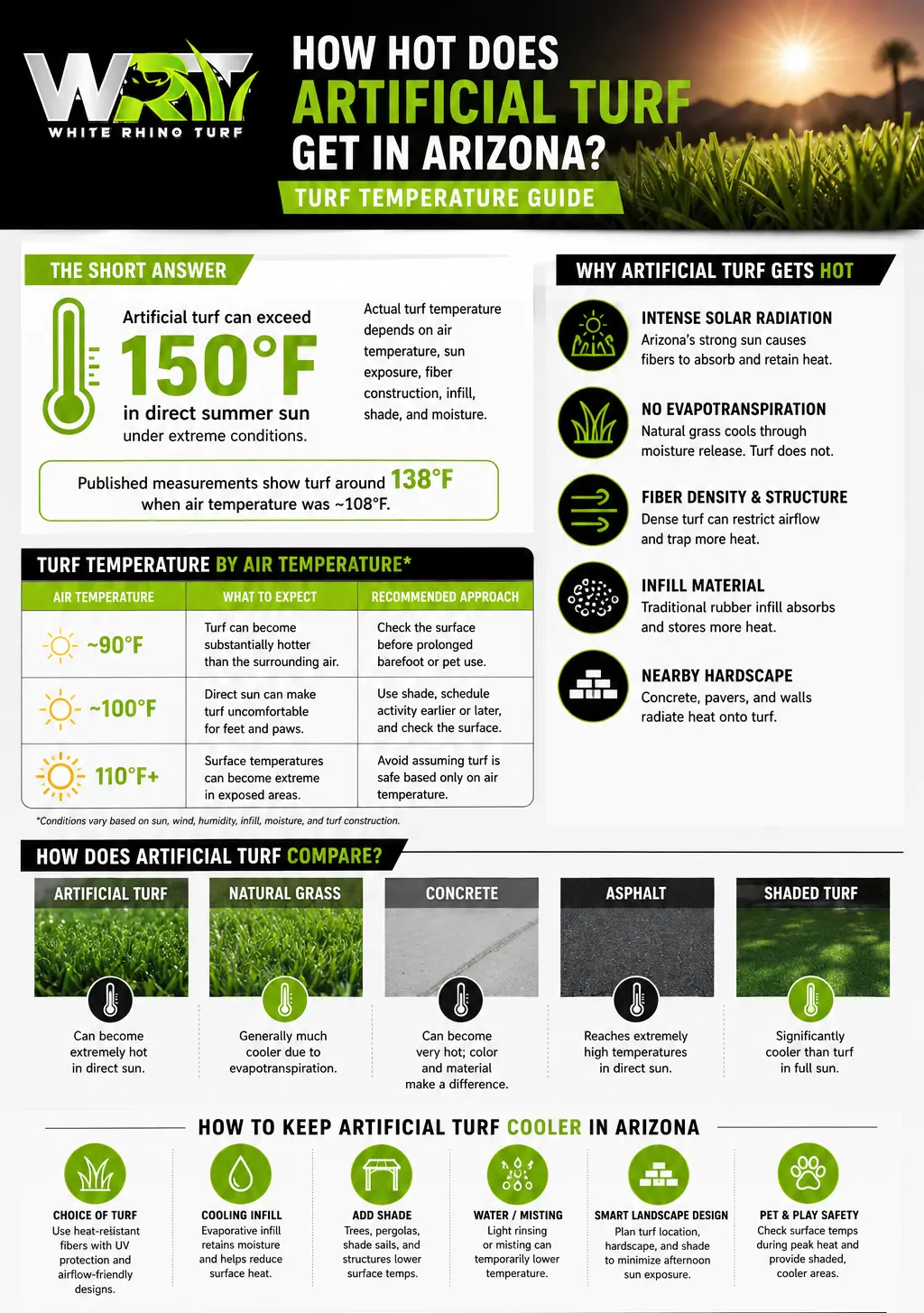
There is no universal formula that converts air temperature into artificial turf temperature. Solar exposure, wind, humidity, blade structure, infill, shade, and moisture can all change the final surface reading.
Still, homeowners can expect the risk of uncomfortable surface heat to increase as both air temperature and direct sun exposure rise.
EPA guidance reviewing synthetic turf research has reported surface temperatures of approximately 120°F to 150°F on sunny summer days when ambient temperatures were around 95°F to 100°F. These figures are not a universal prediction for every artificial lawn, but they illustrate how much hotter an exposed synthetic surface can become than the surrounding air. The EPA’s discussion of elevated synthetic turf temperatures provides additional context.
| Air Temperature | What to Expect From Exposed Turf | Recommended Approach |
|---|---|---|
| Around 90°F | Artificial turf in strong direct sunlight can become substantially hotter than the surrounding air. | Check the surface before prolonged barefoot or pet use. |
| Around 100°F | Directly exposed turf can become uncomfortable for bare feet and paws, particularly during afternoon sun. | Use shade, schedule outdoor activity earlier or later, and check the turf before use. |
| 110°F+ | Surface temperatures can become extreme in exposed areas. | Avoid assuming the turf is safe based only on air temperature. Shade and cooling strategies become especially important. |
This is especially relevant during Arizona heat waves, when outdoor materials have been absorbing solar energy for hours. A turf area that feels comfortable early in the morning can become dramatically hotter by mid-afternoon.
Artificial turf heats differently from living grass because it is made from synthetic materials rather than plant tissue. Several characteristics contribute to higher turf temperatures in Arizona.
Artificial turf fibers absorb energy from sunlight. Phoenix’s clear skies and extended periods of direct sun give exposed turf many hours to accumulate heat, particularly during late spring and summer.
Natural grass releases moisture through the soil and plant blades. As that moisture evaporates, heat is removed from the surface. Artificial turf does not have that biological cooling process.
This is one of the primary reasons healthy natural grass generally stays cooler than artificial grass in full sun.
Very dense artificial grass can restrict airflow between turf blades. Blade shape, pile height, fiber density, and turf construction all influence how heat moves through the turf canopy.
Heat-conscious turf selection is therefore about more than simply choosing the softest or thickest product. Our guide to the best artificial grass for Arizona heat explains the fiber characteristics that matter in desert climates.
Infill sits between the turf blades and plays an important role in blade support, drainage, weight, odor management, and surface performance. Different infill materials can also behave differently in direct sun.
Traditional dark rubber infills tend to absorb considerable heat, while some modern infill products are designed specifically to improve performance in hot climates. Our guide to artificial turf infill for Arizona heat and odor control provides a more detailed comparison.
The turf itself is not always the only source of heat. Concrete walls, pavers, pool decking, block fencing, and other hardscape materials can absorb and radiate solar heat into adjacent portions of the yard.
Projects that combine synthetic grass with hardscape should account for how both surfaces interact with afternoon sun. White Rhino Turf also provides turf and paver combo installation for integrated Arizona backyard designs.
Artificial turf can become hotter than concrete in direct Arizona sunlight, although the comparison varies depending on the materials, color, sun exposure, wind, and moisture.
Artificial turf fibers can absorb and hold solar energy within the blade canopy. Concrete also absorbs heat, but lighter-colored concrete may reflect more solar energy than darker synthetic surfaces. Asphalt is another surface capable of reaching extreme temperatures because its dark color absorbs a large amount of solar radiation.
Instead of thinking of one surface as universally hotter than another, it is more useful to compare how different outdoor materials behave under the same Arizona conditions.
| Surface | Typical Heat Behavior | Why |
|---|---|---|
| Artificial Turf | Can become extremely hot in direct sun | Synthetic fibers absorb solar radiation and do not cool through transpiration |
| Natural Grass | Generally remains cooler | Moisture evaporation and transpiration remove heat |
| Concrete | Can become very hot | Stores and releases solar heat; color and composition matter |
| Asphalt | Can reach extremely high temperatures | Dark material strongly absorbs solar radiation |
| Shaded Turf | Typically much cooler than exposed turf | Reduced direct solar radiation limits heat absorption |
This is why artificial turf temperature should be considered as part of the entire outdoor environment rather than as an isolated material.
In direct summer sun, natural grass is generally cooler than artificial turf. A 2024 systematic review of research on synthetic grass sports surfaces found that surface temperatures were consistently higher on synthetic grass than natural grass, with reported differences ranging from approximately 9.4°C to 33.7°C (about 17°F to 61°F). The peer-reviewed systematic review also found that certain infill and fiber modifications can reduce synthetic surface temperatures.
Living grass has access to moisture in the soil and releases water through evapotranspiration. That process naturally removes heat from the surface. Artificial grass does not have the same cooling mechanism, so surface temperatures can rise more quickly under intense sunlight.
The tradeoff for Phoenix homeowners is that maintaining cool, healthy natural grass during summer requires regular irrigation, mowing, fertilization, and seasonal lawn care. Artificial turf eliminates much of that maintenance and water demand, but surface heat needs to be considered during product selection and landscape planning.
For homeowners comparing the overall pros and cons, our artificial turf vs. real grass in Arizona guide covers water use, maintenance, longevity, appearance, and other differences in addition to temperature.
Artificial turf can become too hot for comfortable paw contact during extreme Arizona heat, particularly in areas exposed to direct afternoon sun.
Dogs interact with turf differently from adults wearing shoes. Their paws are in direct contact with the surface, which makes surface temperature more important than the number shown on a weather app.
Pet owners should avoid assuming that turf is comfortable simply because the surrounding air feels tolerable. During the hottest part of the day, check exposed surfaces before allowing pets to spend extended time outside.
Turf selection matters especially in dog runs and pet areas. Our guide to the best cooling pet turf for hot Arizona climates explains which turf and cooling features can improve performance for pet-friendly spaces.
Helpful strategies for pet areas include:
Pet turf installations also need to address drainage and odor management in addition to temperature. White Rhino Turf’s pet turf installation options in Phoenix are designed around the demands of Arizona pet areas.
Children may sit, crawl, run, or play directly on artificial grass, which makes surface temperature especially important in playgrounds and backyard play spaces.
During peak Arizona summer heat, exposed turf should be checked before extended play. Shaded areas, appropriate turf products, cooling infill, and smart placement of play equipment can all help create a more comfortable environment.
Purpose-built playground turf installation should account for both surface performance and the way children use the space, especially in areas that receive prolonged afternoon sun.
No artificial turf system can eliminate the effects of Phoenix summer sun completely. However, several design choices can reduce heat buildup and improve comfort.
Homeowners planning a new lawn can also explore White Rhino Turf’s cool turf installation options in Arizona, which are designed specifically for properties dealing with intense sun and high surface temperatures.
Not all synthetic grass products use the same fibers or blade structures. Heat-conscious turf may incorporate UV stabilizers, reflective pigments, blade designs that encourage airflow, or fiber technologies intended to reduce solar absorption.
The best product depends on how the space will be used. A pet area, putting green, children’s play space, pool surround, and decorative front yard do not necessarily need the same turf construction.
Some turf infills are designed to retain moisture and use evaporation to help remove heat from the surface. These products can be especially useful in areas where people or pets regularly interact with the turf.
Cooling infill does not make turf immune to Arizona heat. Its performance depends on moisture activation, sun exposure, weather conditions, and the surrounding turf system.
Shade is one of the most reliable ways to reduce solar heat gain because it prevents direct radiation from reaching the turf in the first place.
Useful shade options include:
Even partial afternoon shade can make a meaningful difference in areas that would otherwise receive several hours of direct desert sun.
A light rinse or mist can temporarily lower artificial turf surface temperature. The effect is generally temporary because the surface warms again as the moisture evaporates.
This method becomes more useful when turf incorporates an evaporative cooling infill designed to retain moisture and release it gradually.
A comfortable Arizona yard rarely depends on one material alone. Shade structures, plantings, hardscape placement, irrigation zones, turf location, and the direction of afternoon sun should all be considered together.
The location of turf, patios, trees, walls, and shade structures can influence how comfortable a backyard feels throughout the day. For more design inspiration, explore these artificial turf backyard ideas for Phoenix homes.
Additional practical cooling strategies are covered in our guide on how to keep artificial turf cool in Arizona heat.
HydroChill and similar evaporative cooling infills are designed to hold moisture within the turf system. As the surface heats, that moisture evaporates and removes heat energy from the surrounding turf.
The basic process is similar to other forms of evaporative cooling:
The amount of cooling varies with weather conditions, moisture levels, turf construction, and exposure. Cooling infill should therefore be considered one part of a broader heat-management strategy rather than a guarantee that turf will remain cool throughout an Arizona summer day.
The base beneath artificial turf is primarily responsible for stability, grading, and drainage, but the overall construction of the system still matters in Arizona.
A professionally prepared base typically uses compacted aggregate to create a stable surface while allowing water to drain away from the turf.
Proper installation helps prevent:
Base preparation is one part of a larger installation process involving excavation, grading, compaction, turf placement, seaming, and infill. Our six-step artificial turf installation guide explains how those stages come together.
For homeowners evaluating a new installation, our residential turf installation process explains how the base, turf, seams, infill, and finishing work work together in a complete backyard system.
Surface temperature should be one consideration when choosing artificial turf in Phoenix, but it should not be the only one.
A well-planned turf system should account for:
A decorative turf area that is rarely walked on may have different priorities than a backyard used daily by children and dogs. Likewise, a shaded courtyard may not require the same heat-management approach as an exposed west-facing yard.
Homeowners planning a new system can explore heat-resistant turf installation options designed around Arizona’s extreme sun and high summer temperatures.
Artificial turf exposed to direct Arizona summer sun can become significantly hotter than the surrounding air, and extreme surface readings can exceed 150°F. Actual temperatures depend on solar exposure, turf construction, infill, moisture, shade, wind, and surrounding materials.
Phoenix’s intense sunlight and prolonged triple-digit temperatures can cause artificial turf to reach very high surface temperatures, particularly during afternoon hours. Shaded turf generally remains considerably cooler than turf receiving uninterrupted direct sun.
There is no fixed turf temperature for a 100°F day because surface temperature depends on solar radiation, wind, shade, infill, moisture, and turf construction. Artificial turf in direct sun can become substantially hotter than the surrounding air, so the surface should be checked before barefoot or pet use.
Yes. Synthetic turf fibers absorb solar radiation and do not cool themselves through evapotranspiration like natural grass. Direct sun exposure is one of the biggest factors influencing artificial turf temperature.
Artificial turf can become hotter than concrete in some direct-sun conditions, but there is no universal ranking. Concrete color, turf construction, moisture, wind, and solar exposure all affect surface temperature.
Natural grass generally remains cooler in direct sun because moisture evaporating from the grass and soil removes heat. Artificial turf lacks this natural cooling process and can therefore reach higher surface temperatures.
Artificial turf can become too hot for comfortable paw contact during extreme Arizona heat. Pet owners should check the turf during peak afternoon temperatures and provide shade or other cooler areas for dogs to rest.
That depends on the surface temperature at the time. Exposed artificial turf can become uncomfortable or too hot for direct skin contact during peak summer afternoons, so it is best to test the surface before walking barefoot.
Yes. A light rinse or mist can temporarily lower surface temperature. The cooling effect lasts longer when the system uses evaporative cooling infill designed to retain moisture, but the turf will eventually warm again as moisture evaporates.
Turf designed for hot climates may incorporate reflective pigments, UV-resistant fibers, blade structures that improve airflow, and cooling infill. Shade and landscape design can be just as important as the turf product itself.
Evaporative cooling infill can reduce turf temperature while sufficient moisture remains available for evaporation. Performance varies depending on the product, weather, moisture level, turf construction, and amount of direct sun.
High-quality turf designed for desert climates typically uses UV stabilizers to help resist fading and fiber degradation. Product quality, sun exposure, installation conditions, and age all influence long-term appearance.
Artificial turf can become extremely hot in direct Arizona sunlight, particularly during Phoenix’s hottest summer afternoons. Natural grass generally stays cooler, while concrete, asphalt, artificial turf, and other synthetic or hardscape materials can all develop high surface temperatures after prolonged sun exposure.
The best approach is not to pretend that turf does not get hot. It is to design the installation around Arizona conditions from the beginning.
Choosing appropriate turf fibers, using the right infill, incorporating shade, considering pets and barefoot traffic, and planning the surrounding landscape can all improve how an artificial turf system performs during hot weather.
White Rhino Turf installs cool turf systems designed for Arizona heat along with residential lawns, pet areas, playground turf, and other synthetic grass systems built around how Phoenix-area properties are actually used.

White Rhino Turf delivers professional artificial turf installation in East Valley AZ and across Phoenix. From pet turf and putting greens to full backyard transformations, our licensed in-house crews complete most projects in two weeks or less—with warranties and financing that give homeowners peace of mind.