
- Home
- Locations
- Turf Installation
- Services
- About
- Recent Projects
- Blog
- Contact
Planning commercial turf installation in Phoenix requires a different approach than residential landscape projects. Commercial environments experience consistent foot traffic, heavier usage patterns, and greater exposure to environmental stressors. In a desert climate shaped by extreme sun, compacted soil, and seasonal monsoon storms, artificial turf systems must be engineered for durability, stability, and long-term performance.
Across Phoenix and the East Valley, property managers, HOAs, facility directors, and commercial developers are increasingly turning to artificial turf as a practical alternative to natural grass. When designed correctly, turf systems provide reliable surface performance while reducing water demand in a region facing ongoing drought conditions. This guide explains how high-traffic commercial turf systems are planned, what factors influence longevity, and how Phoenix-specific conditions affect installation decisions.
For an overview of professional turf systems used locally, see our guide to experienced artificial turf installation in Phoenix.
Commercial properties place unique demands on landscape surfaces. Unlike residential lawns that see intermittent use, commercial turf areas often experience daily wear from pedestrians, residents, employees, customers, and visitors. Over time, repeated compression and directional movement can cause low-grade turf systems to mat, separate at seams, or lose drainage efficiency.
High-traffic artificial turf is designed to resist these stresses. Dense fiber construction, stronger backing systems, and stable infill materials help turf maintain structure and appearance under continuous use. In Phoenix, where materials are exposed to intense UV radiation and wide temperature swings, durability is not optional—it is foundational.
From a risk management perspective, stable turf surfaces also reduce uneven wear patterns that can lead to trip hazards, surface deformation, and inconsistent drainage.
Not all commercial foot traffic behaves the same way. Linear walkways experience concentrated wear paths, while courtyards distribute traffic more broadly. Dog runs introduce rotational movement and localized compaction, while retail centers and office campuses combine standing loads with directional flow.
Identifying these patterns early helps guide decisions about fiber density, pile height, infill selection, and seam placement. Areas where people congregate—such as shaded seating zones or building entrances—benefit from reinforced backing and deeper base preparation to prevent indentation.
This planning approach is central to effective commercial turf installation services that prioritize long-term performance over short-term aesthetics.
Commercial artificial turf products vary significantly in performance characteristics. Nylon fibers offer the highest durability and resilience, making them suitable for heavy-traffic environments. Polyethylene fibers provide a softer feel and are often blended with nylon to balance comfort and strength.
Face weight—the amount of fiber per square yard—is a key indicator of how well turf resists matting and recovers after compression. Higher face weight products generally perform better in high-traffic commercial applications.
Backing systems also matter. Polyurethane backings maintain dimensional stability under extreme heat and help secure fibers more effectively than latex alternatives. These features are especially important in commercial artificial turf Phoenix installations exposed to prolonged sun and surface temperature fluctuations.
Many commercial systems also rely on materials designed for longevity, such as those featured in premium turf built to last.
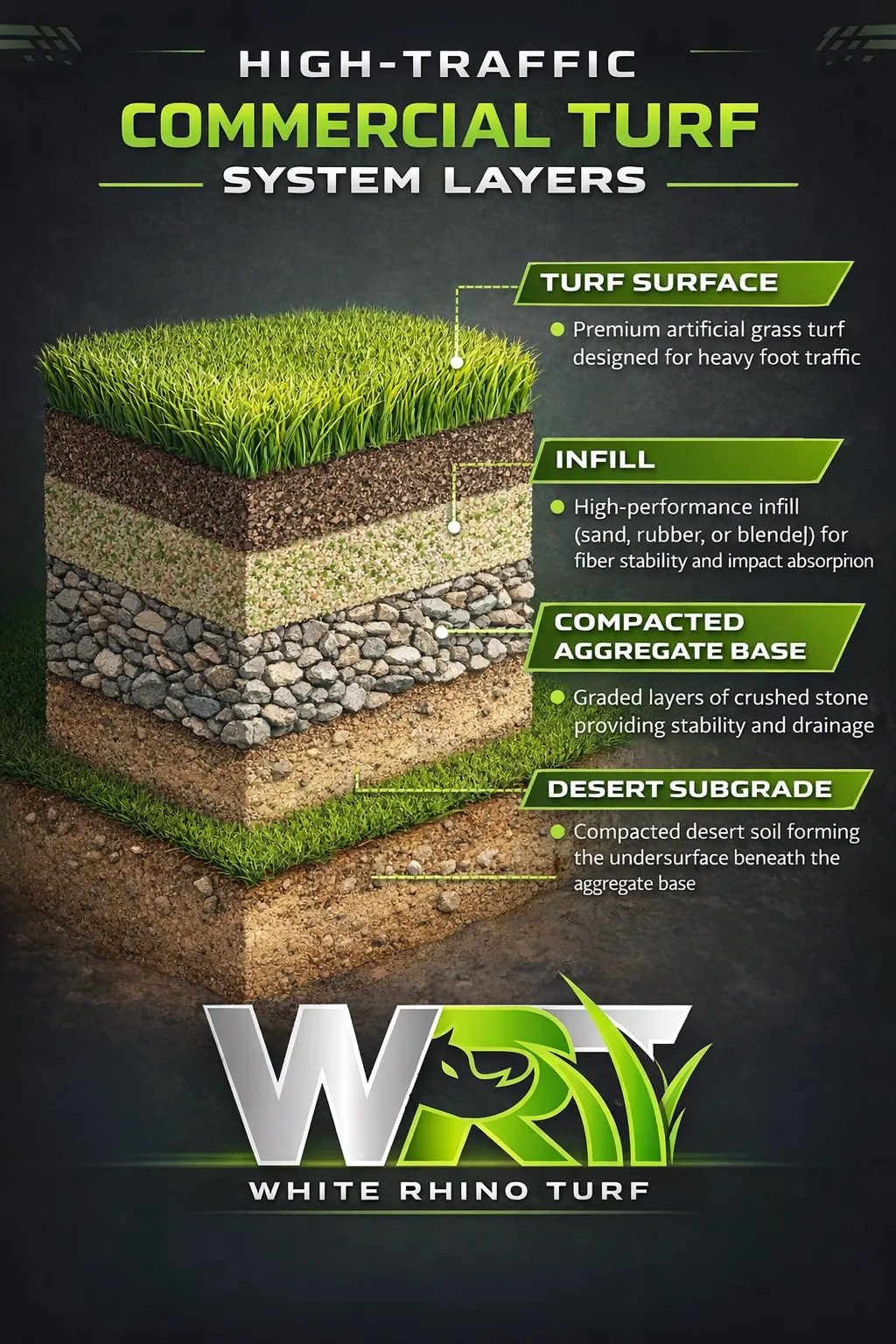
Most commercial turf failures originate below the surface. Base preparation determines how well a turf system supports weight, manages water, and resists movement over time. In Phoenix, native desert soil is often compacted, alkaline, and prone to expansion when saturated.
Commercial installations typically require excavation to remove native soil and replace it with engineered aggregate. This base is installed in layers and compacted to standards appropriate for heavy foot traffic. Proper compaction distributes load evenly, reducing stress on fibers, seams, and infill.
The importance of soil preparation is echoed by land-use and construction guidance from institutions such as University of Arizona Cooperative Extension, which highlights how desert soils behave under moisture and load.
Although Phoenix is arid for much of the year, monsoon season introduces short, intense rainfall events. Commercial turf systems must be designed to handle sudden water volume without pooling or erosion.
Modern turf products feature perforated backing that allows water to pass vertically through the surface. Effective drainage, however, depends on the permeability and grading of the base layers beneath. Engineered aggregate bases allow water to move laterally and vertically away from the surface.
In larger installations, supplemental drainage—such as channel drains or subsurface collection systems—may be required to protect adjacent hardscapes and structures. The City of Phoenix Water Services Department provides guidance on stormwater management principles relevant to commercial properties.
Drainage planning also complements broader water conservation goals outlined by the U.S. Environmental Protection Agency’s WaterSense program.
Seams are natural stress points in any turf installation. In high-traffic commercial environments, weak seams can separate under repeated use, thermal expansion, or ground movement.
Professional installations rely on reinforced seam tape, high-strength adhesives, and strategic seam placement to reduce stress. Edges are secured using perimeter restraints that prevent lifting, curling, and migration over time.
Clean transitions between turf and adjacent materials—such as pavers or masonry walls—also improve safety and visual continuity. These considerations are common among professional commercial turf contractors working in high-use environments.
High-traffic artificial turf supports a wide range of commercial applications:
Some properties also incorporate specialized installations such as playground turf installation options where safety surfacing and durability intersect.
Commercial turf systems in Phoenix must perform under some of the most demanding environmental conditions in the country.
UV exposure: Prolonged sun exposure accelerates material degradation. UV-stabilized fibers help preserve color and flexibility.
Extreme heat: Surface temperatures can rise significantly during summer months. Selecting appropriate materials helps limit thermal stress on fibers and backing.
Dust and debris: Desert environments introduce fine particulate matter that settles into turf fibers. Occasional rinsing supports drainage performance and appearance.
Soil movement: Desert soils expand when saturated. Proper excavation and engineered bases mitigate movement that could disrupt turf systems.
Artificial turf significantly reduces maintenance compared to natural grass, but commercial installations still benefit from routine care. High-traffic areas may require periodic brushing to redistribute infill and restore fiber orientation.
After monsoon events, inspections help confirm that drainage pathways remain clear and edges secure. Predictable maintenance routines are one reason many property managers prefer turf for commercial spaces.
Commercial artificial turf is a long-term infrastructure decision. When designed and installed correctly, systems commonly perform for 15 to 25 years. Lifecycle planning should account for future usage changes, tenant turnover, and site modifications.
Adaptable turf systems allow commercial properties to evolve without requiring full replacement. Reinforced bases and modular layouts support future landscape updates or adjacent hardscape changes.
Effective commercial turf installation in Phoenix depends on thoughtful planning, durable material selection, and installation practices aligned with desert conditions. High-traffic commercial environments require turf systems engineered for stability, drainage, and long-term resilience.
By understanding traffic patterns, preparing a stable base, reinforcing seams, and accounting for Phoenix’s unique environmental challenges, property owners can create functional, attractive landscapes that perform year after year. To learn more about how these principles are applied in real-world projects, visit White Rhino Turf’s expertise.

White Rhino Turf delivers professional artificial turf installation in East Valley AZ and across Phoenix. From pet turf and putting greens to full backyard transformations, our licensed in-house crews complete most projects in two weeks or less—with warranties and financing that give homeowners peace of mind.